
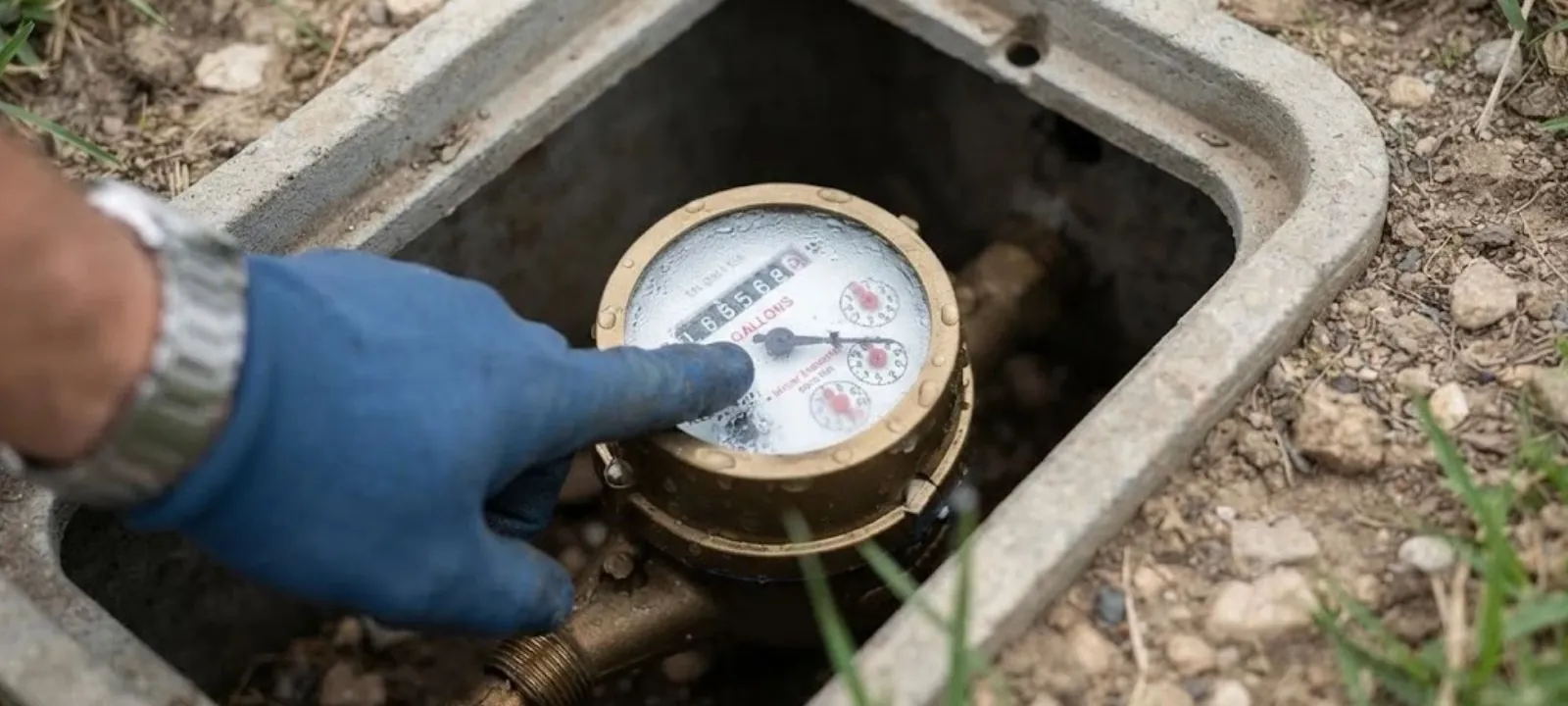
A hidden leak is water escaping between the meter and your fixtures, adding to your bill month after month. It might be a toilet that never quite seals, a sprinkler valve that sticks, or a cracked line in the yard. The meter in front of your house is the fastest way to tell whether the water is really being used, and what to do next.
Reading the meter and running the fifteen minute test
Your water meter is usually in a ground box near the street. If your meter box has a lid and you are comfortable, ask Pelham Water Works at (205) 620-6420 first. Otherwise read the dial through the window if there is one and call us.
Do not reach into the box, since insects can nest there. Some meters have a leak indicator, often a small triangle or star that spins whenever water flows, and a register or sweep hand records the total.
Make the house silent
Close all taps, pause the dishwasher and washer, switch off the ice maker, and stop the irrigation timer.
Record the reading
Write down every digit on the register or take a clear photo through the window.
Wait fifteen minutes
Do not flush, run a tap, or open a door to the yard. Any water use ruins the test.
Compare
If the number changed or the leak indicator kept moving, water is leaving the system.
For a longer view, take the same reading at bedtime and again before the first morning use. A difference overnight is a stronger signal than a short check.
Where the water usually goes, from likeliest to least
| Culprit | Clue | Quick check |
|---|---|---|
| Toilet flapper or fill valve | Faint hiss or refilling without a flush | Add food coloring to the tank and wait |
| Irrigation valve or sprinkler line | Soggy zone, weak heads, or movement only when the system runs | Close the irrigation shutoff and retest the meter |
| Water heater connection or relief valve | Dampness or drip near the heater | Look for moisture at the fittings and discharge pipe |
| Supply line inside a wall or floor | Stain, warm spot, or sound of running water | Close the house main and see if the meter stops |
| Line from the meter to the house | Meter keeps moving after the house main is closed | Check the yard for wet ground or sinking soil |
A running toilet is the repair most worth checking yourself, and the toilet repair page explains what a worn flapper looks like. Dripping faucets and hose bibs also waste water, but the policy below excludes them, so fix them early.
How the Pelham Water Works leak adjustment works
The City of Pelham's leak adjustment policy page describes a credit that can reduce a bill after a qualifying leak is repaired. This is the policy at time of writing, so confirm current terms with Pelham Water Works at (205) 620-6420 or the City of Pelham at 205.620.6400 before you rely on it. We do not promise a credit, since the city decides each request. Source: City of Pelham leak adjustment policy page.
To qualify, your usage must exceed 1.5 times the average of the preceding three billing cycles. The leak must not have been readily detectable and must not come from negligence. The account must be paid in full.
What the policy generally excludes
Fixture and habit leaks are treated differently from hidden pipe leaks.
- Leaking toilets
- Dripping faucets and hose bibs
- Filling a pool
- Fixtures left on
- Water run to prevent freezing
- Irrigation left on
Paperwork matters. Documentation is due within 60 days after the repair. It includes the Leak Adjustment Form plus at least one of a plumber's invoice, receipts for materials, or photos of the repair. You can apply online through the City of Pelham form.
Only one adjustment is allowed per 12 months per service address. The credit covers no more than the two highest consecutive months in the six months before the repair. Late fees are not adjusted, and sewer adjustments are considered only alongside an approved water adjustment.
The published formula is the minimum bill plus half of the difference between the leak month bill and the minimum bill. The city's own wording may contain a typo, so confirm the math with the city before you budget around it.
Bring this when you call
Having these together makes the call with the city or a plumber shorter.
- The last several water bills
- The meter reading you wrote down
- Photos of the repair
- The plumber's invoice
- The Leak Adjustment Form
Making the invoice work for you
A plumber's invoice is strongest when it says what was found, where, and when it was fixed. Ask the plumber to write the location in plain words. Take your own photos of the broken part before it is replaced.
Do not wait for the next bill, because the 60 day window starts after the repair. A full leak detection visit that pinpoints the leak also gives your invoice a clear description of where the water was escaping.
What a plumber can see that you cannot
A homeowner can run the meter test, but not hear a hiss in a buried pipe or map warm water under a floor. A plumber may use listening equipment, thermal imaging or pressure testing, depending on the job, to separate one failing section from a house of healthy pipes. The meter only measures supply water, so a stain that spreads while the meter stays still may be a drain or condensation problem.
When the meter keeps moving after the house is isolated
Close the house main, wait a few minutes, and look again. If the dial still spins, the leak is between the meter and your shutoff. That is the line water service line repair covers, and the fix can mean replacing a stretch of pipe in the yard.
Confirm the meter-side boundary with Pelham Water Works before you start digging, and call 811 first. If a pipe has already failed outright and water is spraying, treat it as a burst pipe and call the 24/7 line right away. We serve Pelham and nearby towns, including Alabaster.
What decides the cost of a bill-leak visit
The price depends on where the leak is and how hard it is to confirm.
Ask for a clear price before work starts. Ask your insurer what your policy covers and keep photos and the plumber's invoice. To get a real number, call us with your meter reading.
Meter spinning and you are not sure why?
Tell the dispatcher what the meter did during the test. A licensed and insured plumber can book a same-day appointment when available.
Questions about meters and big bills
Most leaks are hidden. A toilet leaking into the bowl, a sprinkler valve stuck open, or a cracked yard line can run all day without a wet spot. Start with the meter test.
Start with fifteen minutes. If the meter does not move but your bill is still high, compare readings at bedtime and first thing in the morning with no water used in between.
It may. The city has a leak adjustment policy with usage thresholds, exclusions, and a 60 day documentation window. That is the policy at time of writing, so confirm current terms with Pelham Water Works.
The city decides each request, and nothing here is a promise of a credit.
Keep the plumber's invoice, receipts for materials, and photos of the repair. The city asks for the Leak Adjustment Form plus at least one of those documents. Also keep the bills for the two highest months.
If water is spraying or flooding, close the main and call the 24/7 line. This page is for planned diagnosis of a bill or dial. A true emergency goes to dispatch right away.