
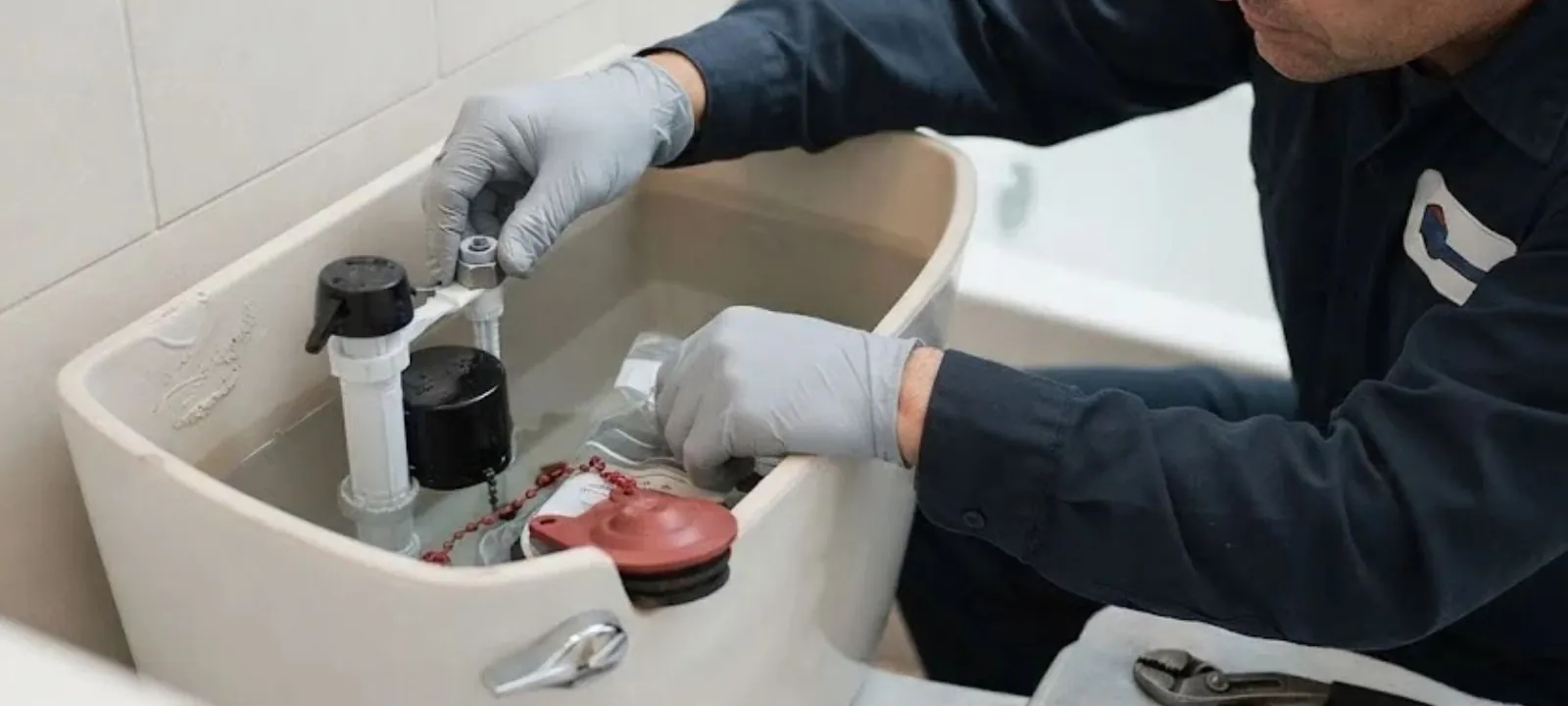
A toilet that is overflowing or leaking onto the floor is urgent, and our 24/7 emergency dispatch sends licensed plumbers for toilet repair and installation in Pelham, AL. Toilet repair means fixing the parts that flush, fill, seal, or anchor the toilet. Right now, turn the oval valve on the wall behind the bowl clockwise to stop the water, then call us once it has stopped.
If that valve is stuck or the water keeps coming, shut off the main water valve for the house. If you cannot find it, call the 24/7 line and the dispatcher will talk you through it. Do not flush again to test it.
If there is standing water near an outlet or a plugged-in fan, keep out of the room, and switch off power to the area at the breaker only if you can reach it from dry footing. Same-day appointments when available, and after-hours and weekend calls reach the same 24/7 emergency dispatch line.
Emergency toilet overflows: the first few minutes
An overflow usually has one of three causes. The drain is blocked below the bowl, the fill valve is stuck open, or the tank is leaking into the bowl. The wall valve stops the first two right away. The third is quieter, so listen for a faint hiss when nobody has used the toilet.
If the water came up from the drain, treat it as dirty. Keep children and pets out, wear gloves, and ask your insurer or a cleaning company about sanitizing. A plumber stops the source, and cleanup is a separate job.
If the bowl rises when you flush and drains slowly, stop flushing. A flanged plunger can move a soft blockage, and a closet auger reaches further without scratching the porcelain. If the shower or a sink nearby also gurgles, the blockage may sit past the toilet, and drain cleaning with a cable or camera fits better than more plunging.
A tank that runs, hisses, or refills by itself
Inside the tank, the flapper is a rubber seal that lifts when you flush and drops to close the drain hole. When it warps or grows a film of mineral, water slips past it into the bowl, and the fill valve tops the tank up every few minutes. You hear a short burst of refilling with nobody in the room. A flapper is a small part and often a quick swap.
To test for a silent leak, put a few drops of food coloring in the tank and wait fifteen minutes without flushing. Color in the bowl means the flapper is leaking.
Water at the base: wax ring, flange, or supply line
A puddle at the base can come from three places. Dry the floor completely, then watch. Drips at the wall valve point to the supply line, drips under the tank point to the tank bolts, and water that appears only after a flush points to the seal under the bowl.
That seal is a wax ring, a donut of wax between the toilet and the drain flange in the floor. When it fails you may see water at the base after flushing, smell sewer gas, or feel a soft spot in the floor. Replacing the ring means lifting the toilet, so it is also the moment to inspect what the toilet sits on.
The flange is the ring the toilet bolts to. If it is cracked, rusted, or sits below the finished floor, a new wax ring will not hold. Repair options include a repair ring, a spacer extension, or replacing the damaged section. Soft or stained subfloor needs attention before any toilet goes back down.
Rocking, cracked, or weak flush
A toilet that rocks has loose closet bolts, an uneven floor, or a failed seal. Shims and new bolts fix the first two, but a toilet that has rocked for a while may have damaged the flange, so a plumber looks underneath before tightening.
A hairline crack in the tank or bowl usually means replacement, because porcelain cannot be reliably repaired. A weak flush can mean mineral-clogged rim jets under the lip of the bowl, a low water level in the tank, or a partial blockage. A plumber checks all three.
| What you see | Usually repaired | Usually replaced |
|---|---|---|
| Constant running | New flapper or fill valve | Tank is cracked or the porcelain is stained through |
| Water at the base | New wax ring, bolts, or flange repair | Bowl has a hairline crack or the base is chipped |
| Rocking | Shims, bolts, or a reset on a repaired flange | Base is damaged or the toilet no longer sits flat |
| Weak flush | Cleaned rim jets or a cleared line | Design keeps clogging even with a clear drain |
When it is not really a clog
Gurgling is a clue. If the toilet bubbles when the washer drains or the shower runs, air is struggling to move through the system. A blocked vent or a partial blockage in the branch line can do it, and plunging the bowl will not help.
Pelham Water Works handles both water and sewer. If several fixtures back up at once, tell the dispatcher. A camera inspection can show where the blockage sits, and Water Works at (205) 620-6420 can tell you whether the public line is involved.
Setting a new toilet
Measure the rough-in before you buy a replacement. That is the distance from the wall to the center of the floor drain. Twelve inches is a common size, but older bathrooms vary, so measure yours.
Shut off and drain
Close the wall valve, flush, and sponge out the tank and bowl.
Pull and inspect
Lift the old toilet and check the flange for cracks, rust, height, and soft flooring.
Set and tighten
Place a new wax ring, lower the bowl, and snug the bolts evenly so the porcelain does not crack.
Test twice
Flush several times and check the base, supply line, and tank bolts for drips.
If the plan includes moving the toilet or adding a second bathroom, that is new rough-in work, and plumbing installation covers it. Permit rules vary by job, so ask the Pelham Building Department at 205.620.6495 before you start.
Toilet work falls under plumbing code, and Alabama's Plumbers and Gas Fitters Examining Board rule 720-X-1-.02 names the 2021 International Residential Code for residential plumbing. Check the board for the current edition, and you can verify any plumber in its Licensee Search at pgfb.alabama.gov.
What changes the price of a toilet job
The price depends on what is actually wrong.
Ask your insurer what your policy covers and keep photos and the plumber's invoice. Call the dispatch line and you get a clear price before work starts.
Pelham water bills and the toilet exclusion
Pelham Water Works lists leaking toilets, dripping faucets, and hose bibs as excluded from its leak adjustment policy. That is the policy at time of writing, so confirm current terms with Pelham Water Works at (205) 620-6420, and see the high water bill guide for the full picture. Because leaking toilets are excluded, a running toilet is better fixed quickly than argued over later.
Keep the invoice either way. If the bill jumped and no fixture explains it, a hidden leak is worth testing for, and leak detection can find one. We serve Pelham and nearby towns, including Alabaster.
Toilet leaking or overflowing?
Call the 24/7 line, tell the dispatcher what you see, and keep the wall valve closed until the plumber says otherwise.
Toilet questions, answered plainly
Yes. Dispatch runs 24/7, including overnight, weekends, and holidays, and a licensed plumber is sent for overflows, active leaks, and toilets that will not stop running water into the home.
Same-day appointments when available. Close the wall valve first, tell the dispatcher what you see, and they will say what is open.
Not for long. A slow leak at the base soaks the subfloor and can rot the subfloor around the flange, and a failed seal also lets sewer gas into the room.
Until it is fixed, close the wall valve between uses, put a towel and bucket at the base, and keep the bathroom floor dry.
Pelham Water Works lists leaking toilets as excluded from its leak adjustment policy. That is the policy at time of writing, so confirm current terms with Pelham Water Works at (205) 620-6420.
See the high water bill guide for what to check on a high bill.
A crack in the porcelain, a base that no longer sits flat, or several parts failing in a year point toward replacement. A running tank or a bad seal usually does not.