
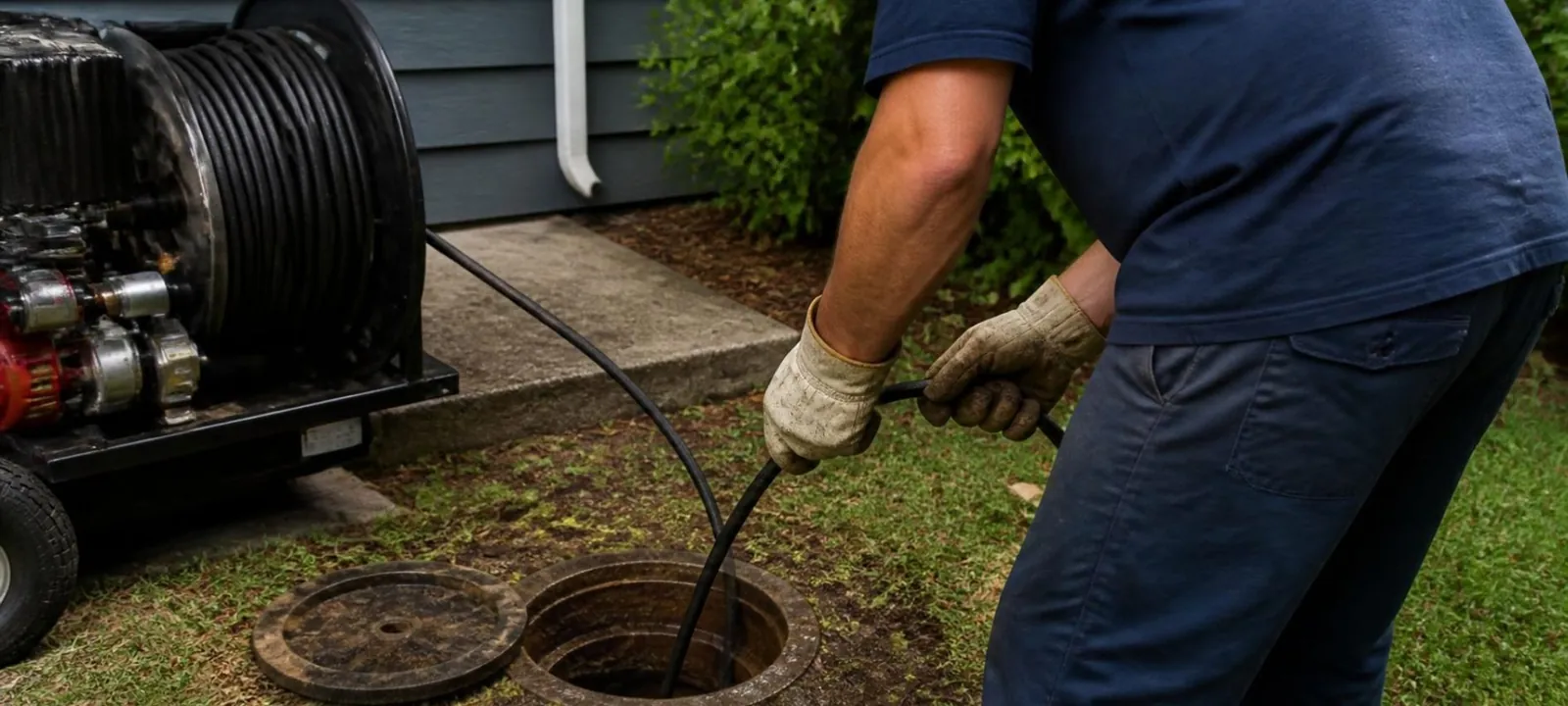
When the lowest drain in the house fills with dirty water, the main sewer line is the likely cause, and our 24/7 emergency dispatch treats it as urgent. Sewer line cleaning is the removal of grease, roots, wipes and debris from the pipe that carries everything from your house to the public sewer. Stop using water, keep people out of the wet area and call from a dry spot so the plumber knows which fixtures are backing up.
Find the cleanout, then leave the cap alone
A cleanout is a capped pipe that gives a plumber direct access to the sewer line. Look along the outside wall nearest the street, in the yard between the house and the road, or inside a basement, garage or crawlspace. The cap is usually a round plug in plastic or iron, and the pipe underneath is often four inches across.
Do not open it yourself. Pressure behind a blockage can push sewage out the moment the cap loosens. A plumber opens it slowly and reads what it shows, and that tells where along the line the trouble sits. Knowing where it is, and clearing shrubs and stored boxes, saves search time on the visit.
Checks you can make without opening anything
You can learn a lot by looking. Check the ground around an outdoor cleanout for wet soil or a sewage smell, which may mean the line is full. Then look at the pattern. One slow fixture usually points to its own branch, while several fixtures at once, especially the lowest ones, point to the main.
A toilet that gurgles when the washer drains, or a shower that backs up when a toilet flushes, is another sign the shared line is involved. Look, but do not touch. Sewage on a floor is a health hazard, so skip any test that puts your hands or face near it.
If you cannot find a cleanout
Some houses have no cleanout, or it is buried or hidden under a deck or landscaping. A plumber may then reach the line by pulling a toilet or going in through a vent stack, which is slower and is one reason the price depends on access. Ask whether adding a cleanout makes sense, since it simplifies every later cleaning and camera run.
Adding a cleanout is plumbing work covered by code. The Alabama Plumbers and Gas Fitters Examining Board's rule 720-X-1-.02 names the 2021 International Residential Code (IRC) for residential plumbing, and the board can confirm the current edition.
Emergency backups: the first hour
A backing-up main is an emergency at any hour, and weekend and night calls are routine for dispatch. Sewage on a floor should not wait for the next opening, while a line that is slow but still draining can suit a same-day appointment when available.
- Stop all water use, including laundry, dishwashers and showers.
- Do not flush. Every flush adds to the water already looking for a way out.
- Keep children and pets out of the room. If water stands near outlets, appliances or a panel, keep out and call the 24/7 line, and switch off power at the breaker only from dry footing.
- Open windows if there is a strong smell, and wear rubber gloves for any cleanup.
- Ask your insurer what your policy covers, and keep photos of the water and the plumber's invoice.
What to tell the dispatcher
A few details speed up the call. Say which fixtures are backing up, which one is lowest, and whether the toilets gurgle when other water runs. Say whether a neighbor has the same trouble, which you can learn by asking from a safe distance, and when the line was last cleared.
Also say if anyone has poured chemical drain cleaner down the line. It may still be sitting in the trap or the pipe when the cleanout is opened, so the plumber should know before starting.
Cable, jetter or root cutter
A main line is long, and each machine suits a different blockage. A plumber chooses among these on site, based on what the symptoms and the first pass suggest.
| Machine | Best at | Limit |
|---|---|---|
| Cable machine | Cutting through a plug and thin roots to get flow back | Leaves a film on the pipe wall, so the line can refill |
| Root cutter head | Chewing thick roots that block the bore | Roots regrow unless the entry point is fixed |
| Jetting hose | Scouring grease and scale from the whole circumference | Needs sound pipe, as explained under hydro jetting |
| Camera | Showing what the machines are meeting | Cannot see past a full pipe until it is partly cleared |
Why store-bought opener does not clear a main
Chemical openers are made for a small trap, where the product can sit on the clog. A main line moves gallons with every flush, so the chemical dilutes and drifts downstream without reaching the stoppage. It also eats at old fittings and leaves a hazard for the plumber who opens the line. The same goes for a single sink, which is covered under drain cleaning.
Roots and wipes are solid material. Chemicals cannot dissolve them. If chemical was already used, wear gloves and eye protection near any opening, or leave it to the plumber. A machine can cut or pull the material out, which is how a stoppage like this is opened.
If it keeps filling
If the main fills once and never again, treat it as a one-off. If it fills again within a year or two, ask for a camera look. The footage can show roots entering at a joint, a sag that holds water, or wipe buildup that points to household habits.
Roots tend to return at the same spot, so a line with a known root entry may fill again after cutting. The lasting fix is repairing the joint, which is covered under sewer line repair. See sewer camera inspection for what the footage shows.
What goes into the price of a main line cleaning
Main line work is priced by effort and access, not by a flat rate.
Coverage varies by policy, so ask your insurer what yours covers and keep photos and the plumber's invoice. You get a clear price before work starts. Call and describe your line for a real number.
House line or city main: a quick check
Pelham Water Works runs the sewer in Pelham, so a backup raises the question of whose pipe is full. When a plumber opens the cleanout, a dry one with a backing-up house suggests the blockage sits between the cleanout and the house. A full one suggests it sits further along, in your lateral or in the public main. Neither reading is certain until the plumber looks further.
Who maintains which part of the line can vary, so confirm the boundary with Pelham Water Works at 205.620.6420. In Helena, the utility is the Helena Utilities Board, which lists a sewer issues line at 205.663.2894. A neighbor with the same backup is a strong clue that it is not only your pipe.
Main line backed up?
Call with the cleanout location and the fixtures that are backing up. A licensed plumber will say what to do while you wait.
Main line questions
Yes. Emergency dispatch runs 24/7, and sewage backing into the house is exactly what it is for. A line that is slow but still draining can suit a same-day appointment when available.
Stop water use, keep people out of the area and call. You get a clear price before work starts.
The cleanout gives a clue, but the plumber reads it. A dry cleanout with a backing-up house suggests a blockage between the two, and a full one suggests the blockage is further along.
A cable or camera confirms it. If the public main is involved, Pelham Water Works at 205.620.6420 is the number to call.
Only as often as it needs it. A line that has run clear for years does not need a calendar.
If it fills again within a year or two, a camera look is the best way to find the cause before booking more cleanings.
A plunger moves water but cannot remove a plug in a long line, and a short hardware-store auger rarely reaches the blockage. Both can push waste back into the house.
If more than one fixture is affected, skip the DIY attempt and call.