
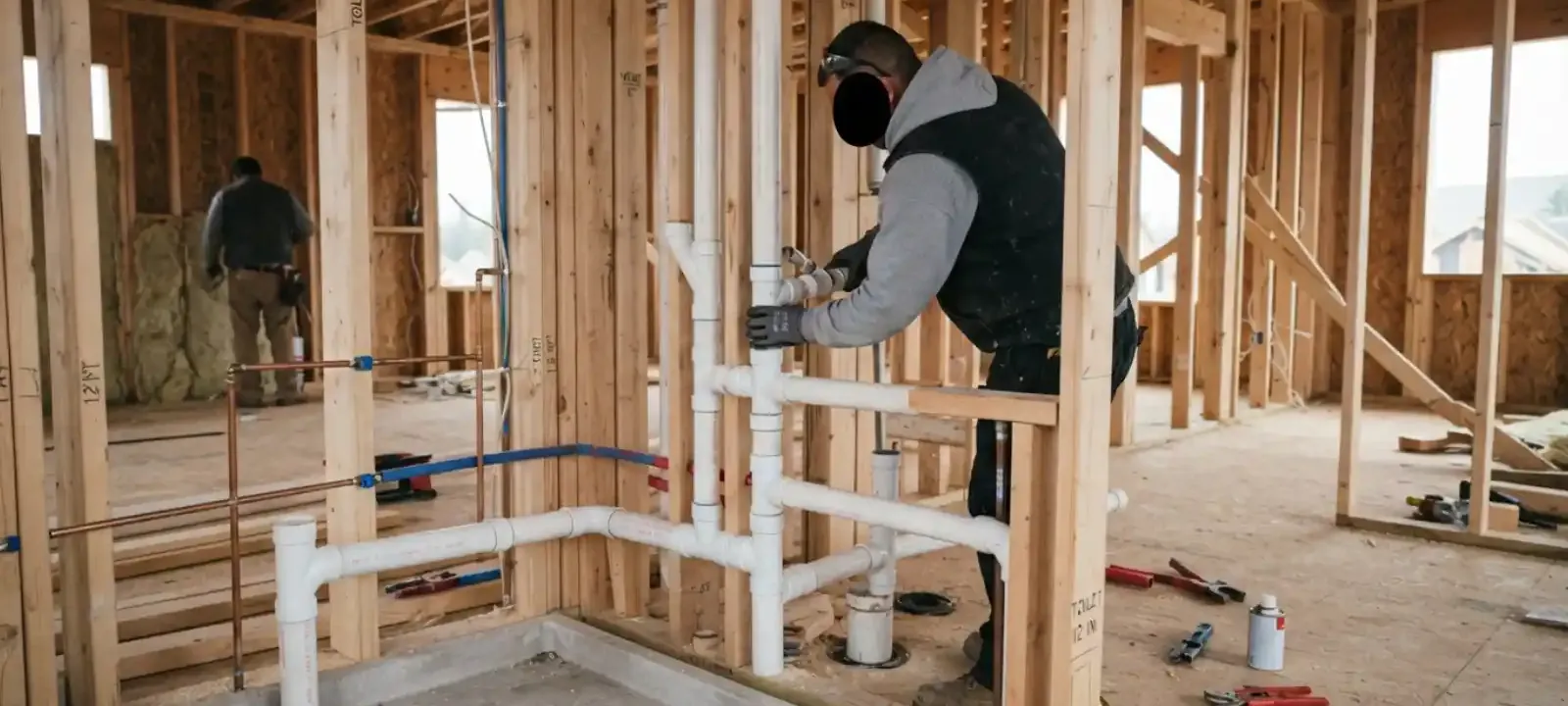
Plumbing installation in Pelham, AL means putting in new water supply lines, drains, vents, and fixtures, either in a remodel or a new space. It is planned work, scheduled around your build or renovation. Call us with a short list of what you are adding, and a licensed and insured plumber will talk through the sequence, the materials, and who should be on site for each stage.
Rough-in, then finish: how the work is sequenced
Larger installations usually have two stages. A single fixture swap is one visit. Rough-in comes first, when the framing is open. The plumber sets drain pipe on a steady downhill slope, runs supply lines, installs vents, and caps the stub-outs where fixtures will go. Nothing is hidden yet, so it is the easiest time to change your mind.
Finish comes after drywall, tile, and paint. This is when toilets, sinks, faucets, and tubs are set, connected, and tested. The two visits can be weeks apart. A drawing that shows the exact fixture locations and heights helps both. Tell the plumber about tile thickness, vanity depth, and the faucet model before the rough-in is set.
Alabama's Plumbers and Gas Fitters Examining Board rule 720-X-1-.02 names the 2021 International Residential Code (IRC) for residential plumbing, and the board can tell you the current edition.
Kitchens and bathrooms in a remodel
A kitchen needs a faucet supply, a drain, a dishwasher connection, and a disposal if you want one. A bath needs a vanity, a toilet, and a tub or shower valve. Decide on the fixtures first, since each has its own rough-in dimensions.
Shower valves are the part to settle early. They sit behind tile, so a valve in the wrong place or at the wrong depth means opening the wall again. If you are choosing a toilet, measure the rough-in distance and see toilet repair and installation for what a toilet set involves. A faucet upgrade is covered under faucet repair.
Moving a fixture or adding a bathroom
Moving a toilet or a sink changes the drain, and drains depend on slope. A fixture far from the vent or the main stack may need a new vent run, and that can mean opening a floor or a ceiling. A fixture on the other side of a wall is usually easier than one in a different part of the house.
Adding a bathroom is a larger job. It needs a drain to the main, a vent, hot and cold supply, and often a floor opening in a slab or crawlspace. Check that the water heater can handle the added demand, and if it cannot, water heater installation belongs in the plan. The City's Building Department page mentions a sewer impact fee when a project connects to sewer. Ask the department at 205.620.6495 whether it applies to your project.
Laundry hookups and outdoor spigots
A washer needs two supply valves and a standpipe drain with a trap. The box on the wall that holds them should be set at the height of the machine and be reachable without moving the washer. A drain pan under a washer on an upper floor is a sensible extra.
An outdoor spigot, or hose bib, runs a supply line through the exterior wall to a valve outside. Frost-proof designs put the shutoff inside the warm wall. Whichever type you choose, disconnect the hose when you are not using it, since a hose left on can trap water against the valve.
Tying new lines into old pipe
New supply lines in a remodel usually connect to whatever pipe is already in the wall. Ask the plumber what that existing pipe is made of before you choose a route, because the join and the fittings depend on it.
If the old pipe looks tired, the better plan may be to replace the whole run instead of tying new pipe into it. See repiping for how the pipe materials compare for whole-house work.
| Stage | What happens | What to have ready |
|---|---|---|
| Before demolition | The plumber reviews plans and the fixture list | Fixture list, water heater location, any drawings |
| Rough-in | Supply, drain and vent lines are set in open framing | Fixture model numbers, tile thickness, vanity depth |
| Inspection | Work is checked before walls are closed, if your project calls for it | The answer from the Building Department on what applies |
| Finish | Fixtures are set, connected and tested | Fixtures on site and the installation sheets |
Working with your general contractor
If a contractor runs the job, the plumber works to their schedule and framing. Share the fixture list and the water heater location early. Ask who is responsible for patching after the rough-in, who orders the fixtures, and who arranges inspection.
If you are running the job yourself, plan the order of work with the plumber. Rough-in happens before insulation, and finish happens after paint. Keep the receipts and model numbers for the fixtures you buy.
Have this ready when you call
A short list saves a second phone call and a second trip.
- A fixture list with model numbers
- Tile thickness and vanity depth
- Where the water heater sits
- Who orders the fixtures
- Who arranges any inspection
What goes into an installation price
Installation is priced after the plumber has seen the space or the plans.
Ask your insurer what your policy covers and keep photos and the plumber's invoice. Ask about the scope in writing and call the office line to get a clear price before work starts.
Permits and the Pelham Building Department
The department at 3162 Pelham Pkwy issues building permits and inspects commercial and residential construction inside city limits. Contractors apply through the Citizen Access Portal, and permit fees are based on the square footage of the improvement, so describe the size of your project when you ask. The office is open Monday to Friday, 7:30 to 4:30, and inspections run Monday to Friday, mornings and afternoons.
We cannot say here whether a permit is needed or who pulls it for your job. Ask the dispatcher what the plan includes and ask the Pelham Building Department about permit rules at 205.620.6495. We serve Pelham and nearby towns, including Alabaster, with same-day appointments when available. Check any plumber's license in the board's Licensee Search at pgfb.alabama.gov.
Planning new plumbing?
Call, describe what you want to add or move, and get the plumbing sequenced before the walls close.
Plumbing installation questions
Before demolition if you can, and before drywall in every case. The plumber needs open walls to run and test the rough-in.
Calling early also lets them flag a vent, a slab, or a water heater issue before it becomes a schedule problem.
Ask when you call, and tell the dispatcher the make and model. Keep the box, the installation sheet, and the receipt.
A plumber can warn you if a fixture needs a rough-in dimension or a part that your wall does not have.
Not always. It depends on the heater's size, how many people use hot water at once, and how far the new bathroom is from the tank.
A plumber can check the capacity and the recovery before you commit.
The Pelham Building Department answers that. Permit rules vary by job, so call 205.620.6495 and describe the work.
Contractors apply through the Citizen Access Portal. If you are doing the work yourself, ask the Building Department what applies.
It depends on what the old pipe is and how it is behaving. If the lines you would tie into leak or clog with rust, replacing the run may be cheaper than opening the wall twice.
The plumber can look at the existing pipe and tell you. Repiping covers the whole-house version of that choice.