
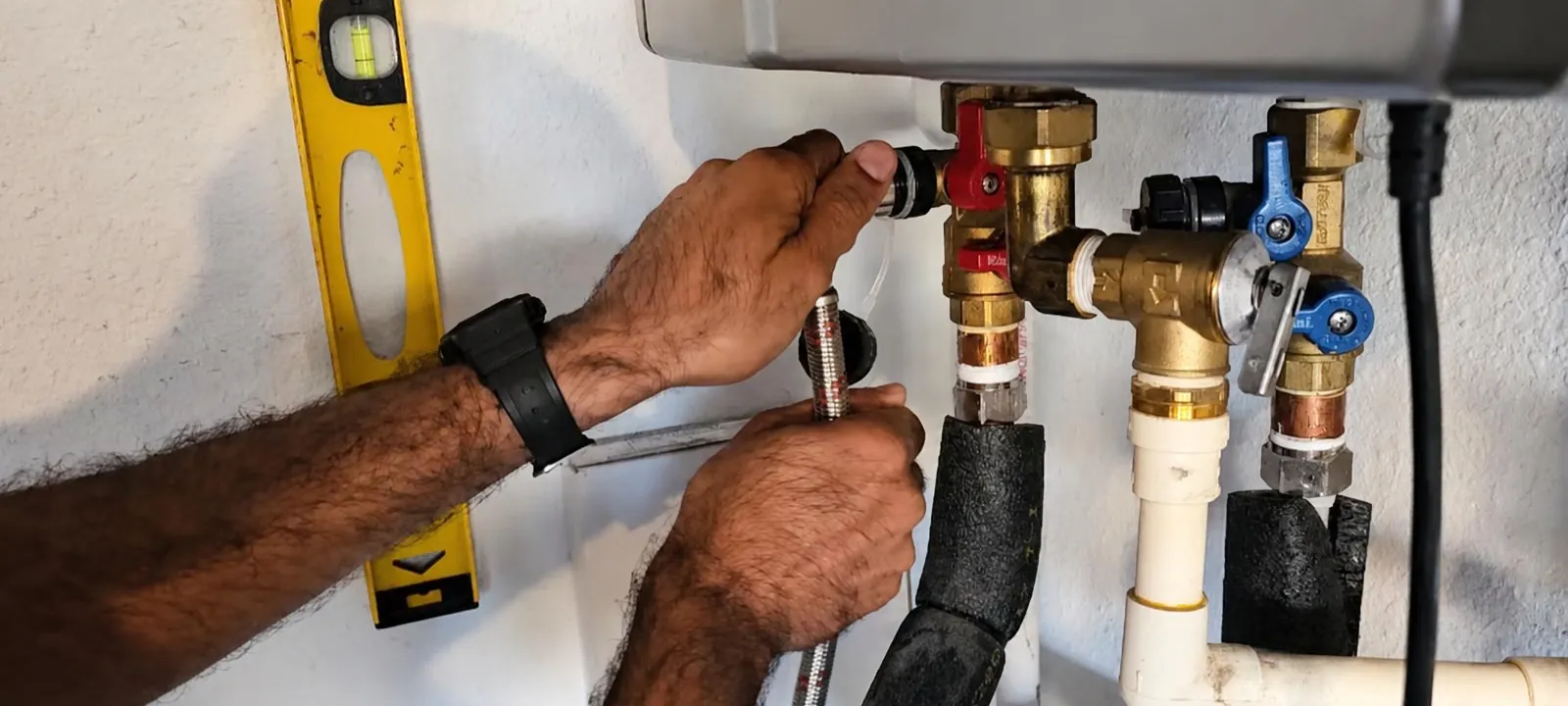
A tankless water heater, also called an on-demand heater, heats water only when a hot tap is open, using a gas burner or electric elements and a heat exchanger. There is no tank of stored hot water. Licensed plumbers can size, install, flush and repair these units in Pelham, AL, and the trade-offs below show when one is not the right fit for a house.
What a tankless heater does well, and what it does not
Hot water never runs out as long as demand stays within the unit's flow rating. That is the main advantage. It also takes up wall space instead of floor space, and it does not keep a tank of water warm all day.
It does not make water arrive faster. You still wait for the cold water in the pipe to clear. Many units also need a minimum flow to fire, so a barely open tap may run cold. Some homes add a small recirculation loop to shorten the wait.
It also costs more to set up than a standard tank, and it needs regular care. If those trade-offs bother you, a conventional or hybrid tank is a sound choice, and the three-way comparison is in the water heater installation guide. To talk it through, call the Pelham line.
How many showers at once? Matching flow rate to your house
Every fixture draws a certain number of gallons per minute, and the tankless unit has a maximum it can heat to your target temperature. Add up what runs at the same time on your busiest morning. If the total is over the unit's rating, the water cools off or flow drops.
- A shower, a dishwasher and a washing machine running together can outrun a small unit.
- Incoming water temperature matters, because colder water takes more heat to raise to the same setting.
- Two units, or a larger one, are common choices for houses with several bathrooms.
- Low-flow fixtures help, but only if everything on the hot side is low-flow.
A plumber can walk your fixtures and tell you a realistic maximum. Do not size by square footage alone.
As a worked example in words, a household that runs a shower, a dishwasher and a washing machine at once needs a unit rated for all three draws together, so add them up before comparing ratings. The same unit heats less water per minute when the incoming water is colder, so a rating that works in one season can struggle in another.
Gas versus electric: what each asks of your house
| Requirement | Gas tankless | Electric tankless |
|---|---|---|
| Fuel or power | A gas line sized for the unit's high peak demand | One or more large dedicated breakers and heavy wiring |
| Venting | Sealed exhaust venting to the outside, often special material | None |
| Water heating strength | Strong output for larger households | Good for small homes or point-of-use, limited by electrical capacity |
| Work beyond the unit | Possible gas line upgrade and condensate drain | Possible panel upgrade, which is an electrician's job |
| Maintenance focus | Flush, vent and burner checks | Flush and element checks |
Panel upgrades and new circuits are electrical work for a licensed electrician, and your plumber can tell you what the unit will need. The gas and exhaust checks that apply to every new heater are laid out under venting and gas line checks.
Alabama's Plumbers and Gas Fitters Examining Board names the 2021 International Residential Code for residential plumbing and gas installations in its Rule 720-X-1-.02. That is the code family a home tankless install sits under, so check the board for the current edition.
Permit rules vary by job, so ask the Pelham Building Department at 205.620.6495 whether yours needs one. If gas is involved, never relight or adjust gas parts yourself. If you smell gas, leave the house and call your gas utility or 911.
Tankless flush and descale: why it matters and what is involved
Minerals in water come out of solution when it is heated, and in a tankless unit they coat the inside of the heat exchanger. That scale insulates the metal, so the unit works harder, makes noise, trips error codes and eventually fails early. A flush is the maintenance that clears it.
Isolate the unit
Gas or power is shut off and the service valves on the inlet and outlet are closed.
Connect a circulation loop
Hoses and a small pump run an approved descaling solution through the heat exchanger and back out.
Circulate
The solution runs for the time the maker specifies, which dissolves the scale.
Rinse and clean the filter
Fresh water flushes the solution out, and the inlet screen is cleaned of debris.
Restart and test
Valves are reopened, the unit is fired and the plumber checks temperature and flow.
How often depends on your water and your usage, so follow the maker's schedule as a starting point. A unit that has been neglected for years may need more than one cycle, and some scale does not come out.
According to Pelham Water Works' 2024 annual water quality report, the city's water comes from its own wells and from purchased Shelby County Water Services supply, and the report lists a wide hardness range. Ask the plumber whether your water justifies flushing at the shorter end of the maker's schedule.
Error codes and cold gaps: reading the symptoms
Tankless units blink a code when something is off. The codes differ between makers, and the manual explains them. In general, they point at a few areas. These include ignition trouble, a blocked vent, a scaled heat exchanger, a flow sensor reading wrong, and a setpoint the unit cannot reach.
- A code after the unit has gone months without a flush often points at scale or a dirty inlet screen.
- A code that comes with a gas smell, soot or an exhaust odor means shut it down and call.
- Water that goes lukewarm with several fixtures open usually means demand has outgrown the flow rating.
- Alternating hot and cold at one tap can come from low flow, a failing sensor or a mixing valve elsewhere in the house.
- Photograph the code and the model plate before you call, so the plumber has them in hand.
What to do before you call a plumber
- If you smell gas, leave the building and call your gas utility or 911 from outside. Do not relight or adjust gas parts yourself.
- If the unit is leaking, close its water service valves or the home's main shutoff valve. If you cannot find it, call the 24/7 line and the dispatcher will talk you through it.
- If there is standing water near outlets, appliances or the panel, keep out and call the 24/7 line. If you can reach the breaker from dry footing, switch off power to the area.
- Do not repeatedly reset a unit that keeps showing the same code.
- Write down the error code and the model plate details so the plumber can look them up.
Resetting a unit once is reasonable. Resetting it repeatedly hides a problem that tends to get worse. The water heater repair page covers tank and tankless faults, and the first step is always to find what is failing before any part is replaced.
When repairing a tankless unit stops making sense
Many faults are fixable. A new flow sensor, igniter, inlet screen or flush solves a lot of problems. A cracked heat exchanger, a failed main board on an older unit or repeated faults after a descale are different, because the cost of parts starts to approach the cost of a new unit.
Ask three questions. How old is the unit, has it been flushed, and does the maker still supply parts for the model? If the answers are old, never and no, replacement is usually the sounder choice, and an expensive part is hard to justify. Our water heater replacement page covers what the swap involves.
When you compare a new unit with repairing the old one, look at the whole cost of ownership. That means purchase and install, the flush schedule, and the expected service life the maker states, not the purchase price alone.
We serve Pelham and nearby towns, and Helena homes are served through the Helena plumbers page. If you are unsure whether to repair or replace, call and describe the unit and its age.
What affects tankless pricing, from install to flush
Tankless work varies more than tank work, because the surrounding gas, vent and electric setup differs from home to home.
Ask your insurer what your policy covers and keep photos and the plumber's invoice. A maker's warranty may require documented flushes, so keep your invoices. Call for a clear price before work starts.
Thinking about going tankless?
Tell the dispatcher about your household and your gas or electric service, and ask whether it fits. Same-day appointments when available.
On-demand heater questions
Follow the maker's schedule as the baseline. In areas with harder water, many owners flush on the shorter end of that schedule or even sooner.
Pelham's mixed well and purchased water means it can vary by street. Ask the plumber whether yours justifies the shorter end.
Usually the combined demand exceeds the unit's rating, so it cannot raise all that water to the set temperature.
A scaled heat exchanger can lower the output, so a flush is worth trying before anything else.
Most gas units still need electric power for the fan, igniter and controller, so they stop in an outage. Electric units stop too.
If outages concern you, ask about a backup power option when planning. Gas shutoff and manual relight guidance should come from the unit's manual, not from guesses.
Sometimes, but not always. A gas unit needs a vent that can reach the outside and a gas line that can carry the load. An electric one needs the circuit.
That is why the plumber looks at the space and service before quoting.
It can be, mostly for the endless supply and the space saved. Two things decide it: whether the gas line and vent need upgrades, and how many fixtures run together at your busiest time.
If the install needs major gas or wiring upgrades that the household will not use, the plumber should be willing to talk you out of it.