
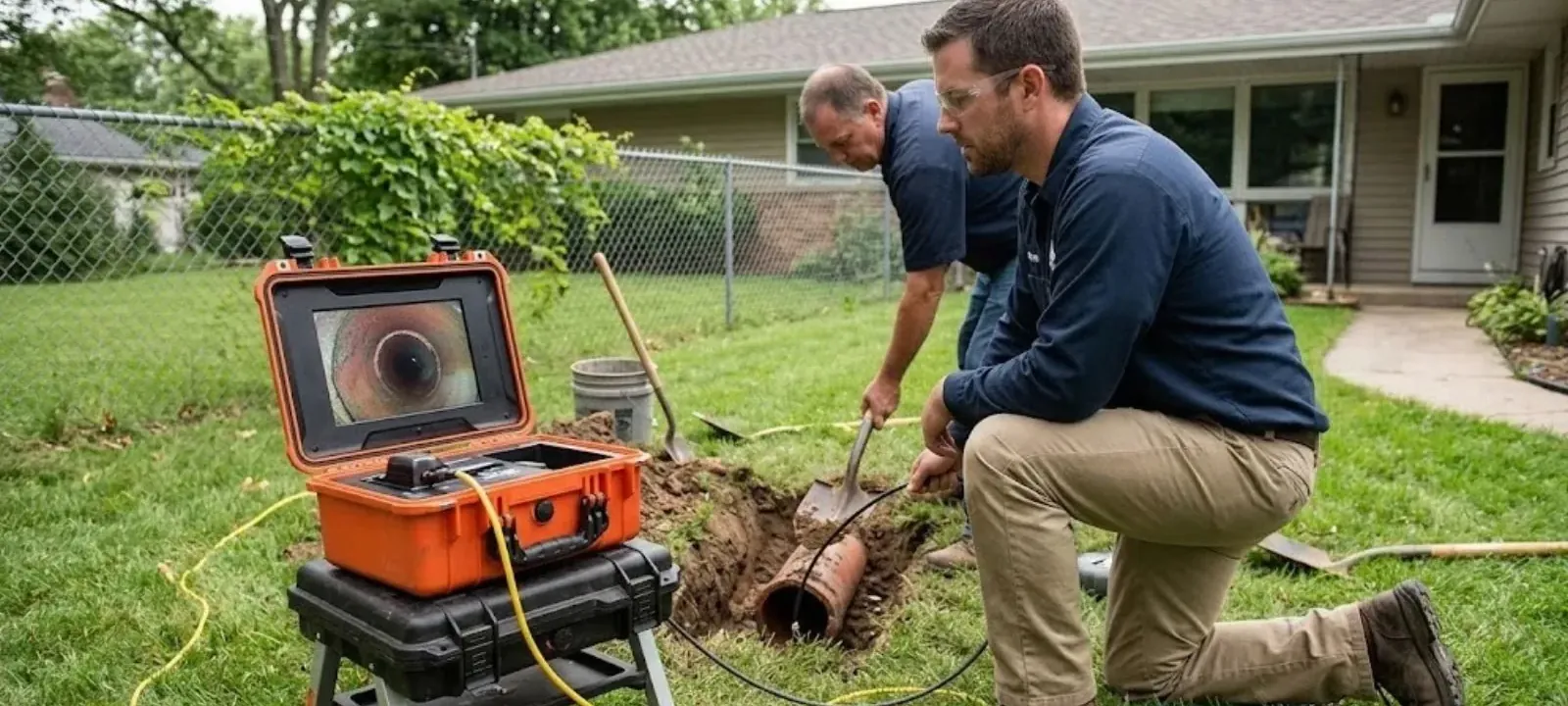
Sewage coming up through a floor drain or tub is an emergency, and 24/7 emergency dispatch can send a licensed plumber to assess it. Sewer line repair in Pelham, AL means fixing a cracked, rooted, offset, collapsed or sagging pipe between your house and the public sewer, whether by digging, relining or replacing the damaged section. Stop all water use, keep everyone out of the affected rooms, and call and say where the sewage is showing.
Sewer emergency: the first hour with sewage in the house
A backup from a broken line looks like a backup from a plain clog, and you cannot tell them apart from the floor. What you can do is limit the damage. Water you run, including every flush, goes into a pipe that cannot take it.
While you wait for the plumber
Shut off water use and leave the toilets alone. If water stands near outlets, appliances or a panel, keep out of that area and call the 24/7 line. If you can reach the breaker from dry footing, switch off power to the area. Keep children and pets out, and wear boots and gloves for any cleanup.
Night and weekend calls are routine for dispatch, and same-day appointments are available when the schedule allows for repairs that can wait. Note when the backup began and which drain showed it first. The pattern helps the plumber decide between a cleaning and a repair. A cleaning is covered under sewer line cleaning.
What actually breaks a sewer line
Roots are the best known cause. They enter at a joint looking for moisture, grow into a mat, and eventually crack the joint apart. Offset joints happen when soil shifts and two pipe sections no longer line up, leaving a lip that catches paper and wipes.
Bellies, or low sags, happen when the soil beneath the pipe settles. Water pools in the dip, solids settle out, and the line backs up even though nothing is broken at the surface. Heavy loads above a shallow line can crush it, and old cast iron rusts from the inside until the wall flakes or splits.
Camera first, then a decision
No repair should be priced from a guess. A camera on a flexible cable can travel the line and show the damage, and a locator at the surface can mark its depth and position. That tells the plumber whether the fault is a single bad joint or a long deteriorated run, and where a dig would need to start.
A line that is plugged may need clearing before the camera can pass. Footage after cleaning often shows the true state of the pipe. You can read about what the footage shows on the sewer camera inspection page, and it is the same evidence the repair choice rests on.
Dig, trenchless or lining: how the options compare
These are the common repair methods. Which of them a plumber can offer depends on the job, so ask what the footage supports before choosing.
| Method | Best when | Trade-off |
|---|---|---|
| Spot dig and replace | One short damaged section, easy to reach | Opens the yard or slab at that point and needs restoring afterward |
| Trenchless pipe bursting | A long failing run with room at both ends | Needs entry pits and a clear path, and it replaces rather than repairs |
| Cured-in-place lining | Cracks and root entry in a pipe that still holds its shape | Cannot fix a collapse, and the liner narrows the pipe slightly |
| Full replacement by trench | Collapsed, crushed or badly bellied line | Most disruptive, but gives a new pipe at the right slope |
The right choice comes from the footage, not a preference. A pipe that has collapsed cannot be lined, and a pipe with one bad joint rarely needs a long trench. Ask the plumber to point to the problem on the video.
What a repair day involves
Before any digging, 811 is called so buried utilities are marked, and you can ask the plumber who is making that call. Ask what the job includes, which part of the yard, driveway or floor will be opened, and what permits apply. Permit rules vary by job, and the Pelham Building Department at 205.620.6495 can say.
Sewer repair is plumbing work covered by code. The Alabama Plumbers and Gas Fitters Examining Board's rule 720-X-1-.02 names the 2021 International Residential Code (IRC) for residential plumbing and the 2021 International Plumbing Code (IPC) for commercial plumbing, so check the board for the current edition.
How a pipe lining job goes
Lining builds a new pipe inside the old one. The sequence below is the general method, and details vary by the product and the pipe.
Clear and inspect
The line is cleaned so the liner can bond, and the camera confirms the pipe still holds its round shape.
Prepare the liner
A flexible tube is soaked in resin and sized to the pipe length.
Pull and inflate
The tube is pulled into place and inflated so it presses against the pipe wall.
Cure
Heat, light or time hardens the resin into a smooth new pipe inside the old one.
Reopen and check
Side connections are cut open and a final camera run confirms the result.
Cast iron in crawlspaces and under slabs
Cast iron drain pipe lasts a long time, but it rusts from the inside, and scale builds up until the bore narrows. Flaking scale and a roughened bore are what the camera shows. Where cast iron runs under a slab, the plumber weighs breaking the floor against relining the old pipe in place.
Where it is reachable in a crawlspace, a failed section can be cut out and replaced with new pipe and couplings. A camera shows how far the damage runs, and that decides between a small repair and replacing the whole stack. Heavy flaking in a cast iron line means the wall has thinned, which is why a plumber may suggest replacing a section rather than patching it.
A septic tank is a different job
This page covers the line from your house to the city main. We do not install or pump septic tanks, and a failing tank or drain field needs a septic contractor. If you are not sure whether your home is on city sewer, ask Pelham Water Works at 205.620.6420.
What drives the cost of a sewer repair
Sewer repair cost depends on what the footage shows, not on one average job.
Coverage varies by policy, so ask your insurer what yours covers and keep photos and the plumber's invoice. You get a clear price before work starts. Call and describe the symptoms for a real number.
A ground warning to report separately
According to the Shelby County Reporter in April 2014, limestone bedrock underlies much of Shelby County, so sinkholes are common. That year a sinkhole opened on Cambrian Ridge Drive in Pelham after heavy flooding, with a void about four feet wide and 22 feet deep beneath a surface depression only two feet across.
If you see a bowl-shaped depression, a leaning tree or a dip in a paved road that holds water near a road or building, keep people away and call the police, who alert Public Works.
That is a ground warning, not a sewer diagnosis. If a depression sits above a line you suspect is damaged, tell the plumber about it when you call. Dial 811 before any digging, and plan to ask the Pelham Building Department at 205.620.6495 about permits and fees. The department also lists a sewer impact fee for projects that connect to the sewer, so ask whether anything applies to a repair.
Pelham Water Works runs the public sewer, and the city says its sewer department meets or exceeds ADEM and EPA standards. Who maintains which part of the line can vary, so confirm the boundary with Pelham Water Works at 205.620.6420 before assuming. If you are in Alabaster, ask the utility there who handles the public main at your address.
Sewer line broken or backing up?
Call, describe the symptoms and where the water shows, and a licensed plumber will start with the camera.
Sewer repair questions
Yes. Emergency dispatch runs 24/7, and sewage in the house is the kind of call it exists for. Damage that can wait, such as a slow drain with no sewage showing, suits a same-day appointment when available.
Stop water use, keep people out of the area, and call. A temporary clearing may be done first to stop the backup, and the repair can then be planned from camera footage.
A plain clog clears and stays clear for a good while. A broken or sagging line refills soon after cleaning, and a backup that returns within weeks is the key tell. The cable may also stop at the same spot every time, and wet patches or sinking soil over the line are other signs.
Only a camera run settles it.
No. Trenchless methods save the yard but need the pipe to be in a condition that suits them. A lined pipe must still hold its shape, and a bursting job needs room for pits.
A collapsed or badly bellied line often needs a trench. The footage decides.
Who maintains which part of the line can vary, so confirm the boundary with Pelham Water Works at 205.620.6420 before assuming. The utility maintains the public main.
A camera run and a locator show where the damage sits relative to that point.
Roots enter through small joint gaps or cracks to reach moisture, then thicken and widen the opening. Over time they can split the joint or lift sections out of line.
Cutting them clears flow, but the joint stays open until it is repaired or lined.