
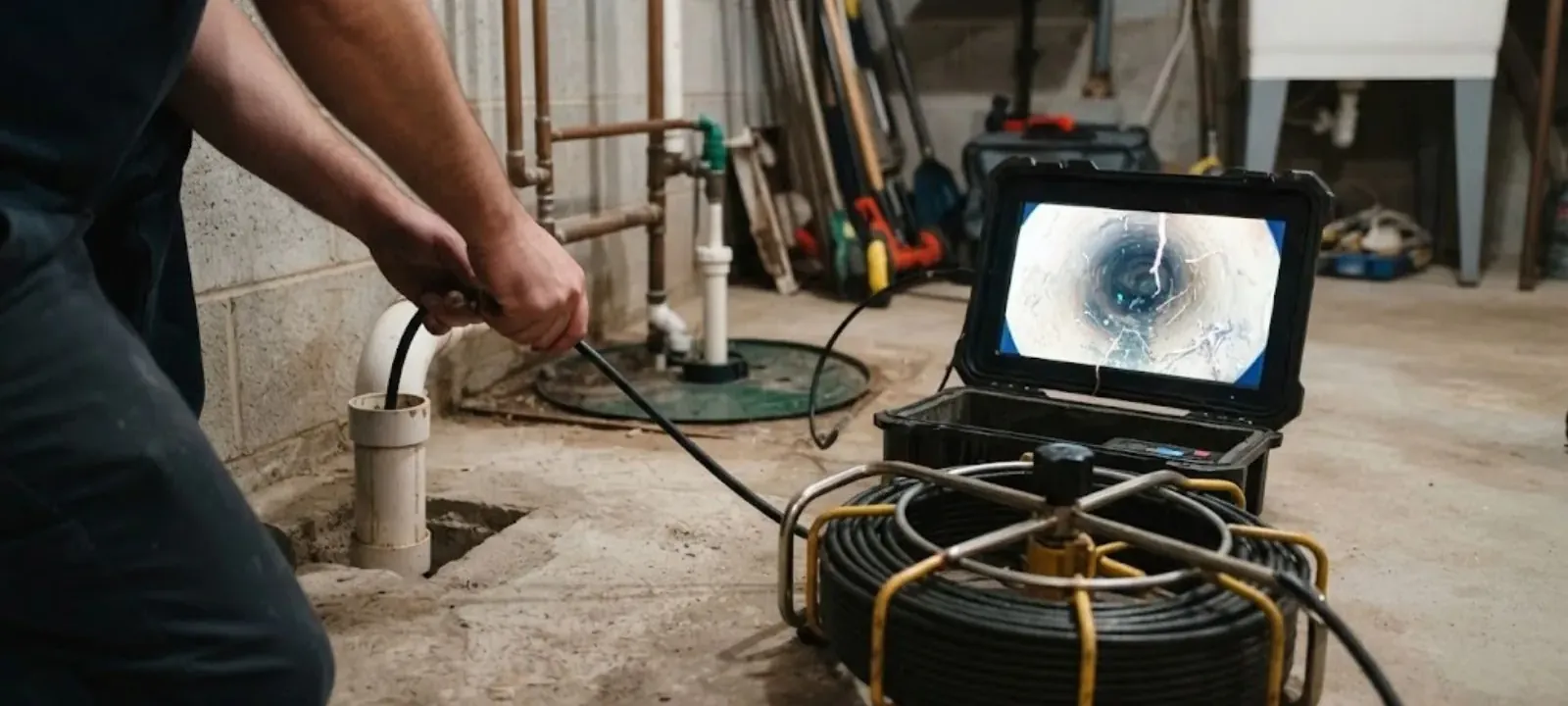
A sewer inspection camera run is a short, planned visit in which a plumber sends a waterproof camera through your sewer line to see what is inside. Sewer camera inspection, also called sewer video inspection, can show roots, cracks, sags, offset joints and buildup that a cleaning never reveals. Same-day appointments are available when the schedule allows, and the visit suits homeowners, buyers and landlords in Pelham, AL.
What a camera shows that cleaning never will
A cable or a jetting hose works blind. It clears a path and tells you only that water now flows. A camera shows why the pipe filled. A plumber can see a root mass pushing through a joint, a wipe collar that formed at a ledge, a sag holding water, or a joint where two sections no longer line up.
The camera head carries a light and a lens on a flexible rod, and a locator at the surface can mark its depth and position. That is how a plumber turns a footage time stamp into a spot you can point to in the yard.
Moments when a camera run pays off
- Before buying a house, so the line is known before the sale closes.
- After two or more stoppages in the same line, to find the cause of the repeat.
- Before a jetting job on an old or doubtful pipe, as explained under hydro jetting.
- After a sewage backup, to see whether the pipe is damaged.
- Before building a deck, pool, addition or driveway over or near the line.
- When a sewer smell, a wet patch in the yard or a sunken spot has no clear source.
Repeat clogs are the most common reason to book. If the same line has needed clearing twice, a third cleaning without footage is guesswork. Pairing the camera with the next cleaning lets the plumber look at the pipe the moment it opens, which can save a second visit.
Planned work also means you can pick the timing. A buyer with a closing date or a landlord between tenants can ask for the earliest open slot when calling, since same-day appointments are available when the schedule allows.
The visit, from cleanout to footage
Find the way in
The plumber looks for a cleanout, and if there is none, the camera may go in through a removed toilet or a vent stack.
Clear if needed
A line that is full or heavily coated may need a pass with a cable first so the lens can see.
Run the camera
The camera travels toward the public main while the plumber watches the screen and notes the distance.
Locate the faults
Each fault is noted by distance and, with a locator, can be marked at the surface.
Go over the findings
Ask the plumber to walk you through what the camera showed and what the next step would be, if any. Ask what you will be given to keep, such as a recording or notes.
Reading the footage
Most findings fall into a few types. The table shows what each looks like and what usually happens next.
| Finding | What it looks like | Usual next step |
|---|---|---|
| Root intrusion | Pale fibrous threads at joints | Cutting, then a schedule or a joint repair |
| Offset joint | Pipe edges that do not line up | Monitor if minor, spot repair if it traps debris |
| Sag or belly | Standing water in a low stretch | Regrade or replace that section |
| Crack or break | A dark seam or open gap | Lining or spot repair, as covered under sewer line repair |
| Heavy buildup | Grease or scale narrowing the bore | Jetting or cleaning |
| Cannot tell | Water in the line, a tight bend, or a point where the camera stops | Clear the line, try another way in, or use a different test |
Not every finding needs action. A minor offset or a thin film of grease can be watched over time. Roots, a sag that holds water or a break are the ones that lead to repair, so ask the plumber to rank the findings by urgency and to say which can wait.
Buying a house with a sewer line you cannot see
A home inspection usually covers the visible plumbing. The buried sewer line is not visible, so a camera inspection is how you see it. A recording can give you something concrete to bring to the negotiation, whether that is a repair credit, a price change or a decision to walk away.
Before you book, ask what the plumber will give you to keep, such as the recording or notes, and ask for each problem to be located by distance from the cleanout.
Ask the seller what they know, since the camera then has something to be checked against.
- The year the house was built and whether the sewer line was ever replaced.
- Any past backups, and what was done about them.
- Records of root cutting or cleanings.
- Where the cleanout is, if there is one.
Buyers looking in Alabaster and nearby towns can book the same visit, and a call before your closing date leaves time to act on what the footage shows.
What a camera cannot do
A camera cannot see through a full pipe, so a blocked line must be partly cleared first. It cannot enter if there is no access point, and it cannot see inside walls or under slabs beyond the pipe it runs through. Tight bends and a collapsed section may stop it.
It also shows only what is in view at the moment. A hairline crack on dry pipe may not show, and a line that only backs up when the whole house runs water may look fine on a quiet day. Tell the plumber about patterns even if the footage looks clean.
What shapes the cost of a camera inspection
The scope of the visit sets the effort, so the same camera can be a short or a long job.
Coverage varies by policy, so ask your insurer what yours covers and keep photos and the plumber's invoice. You get a clear price before work starts. Call to book, and describe your line.
Where your line meets the public main
Pelham Water Works provides sewer in Pelham. Who maintains which part of the line can vary, so ask Pelham Water Works at 205.620.6420 where the public main begins for your address. The camera shows your lateral, the pipe from the house, and the footage can show where it joins the main.
That boundary matters if the footage shows a fault near the street. Take any recording with you when you call, and give the distance from the cleanout. If your home is served by another utility, call that utility instead.
Want to see what is in your sewer line?
Call and book a camera inspection. Tell us if it is for a home purchase, a repeat clog or a new project.
Before you book a camera run
The drivers are the length of the line, how easy the access is, and whether it must be cleaned before the lens can see. A short line with a cleanout is a quicker visit than a long run with no access.
Ask when you call, and the plumber can give a window once the access is known.
A cleanout is the easiest entry point. Without one, the camera may go in through a removed toilet or a vent stack.
If your house has none, installing a cleanout during repair work is worth discussing.
It can show a crack, a gap or a joint that is wet or stained, and a locator can mark its position. A slow leak in a dry pipe may not show.
If the footage is not conclusive, a different test may be needed, and the plumber will say which.
A camera run is how you see the buried line before closing, since a home inspection usually covers visible plumbing. The recording can support a repair credit, a price negotiation or a decision to walk away.
Ask the seller about past backups and repairs as well.
A backup is an emergency, not a planned inspection. Call the 24/7 line, stop water use and keep people out of the affected area.
The plumber will usually clear the line first, then run the camera to find the cause. Emergency work is covered under sewer line cleaning.