
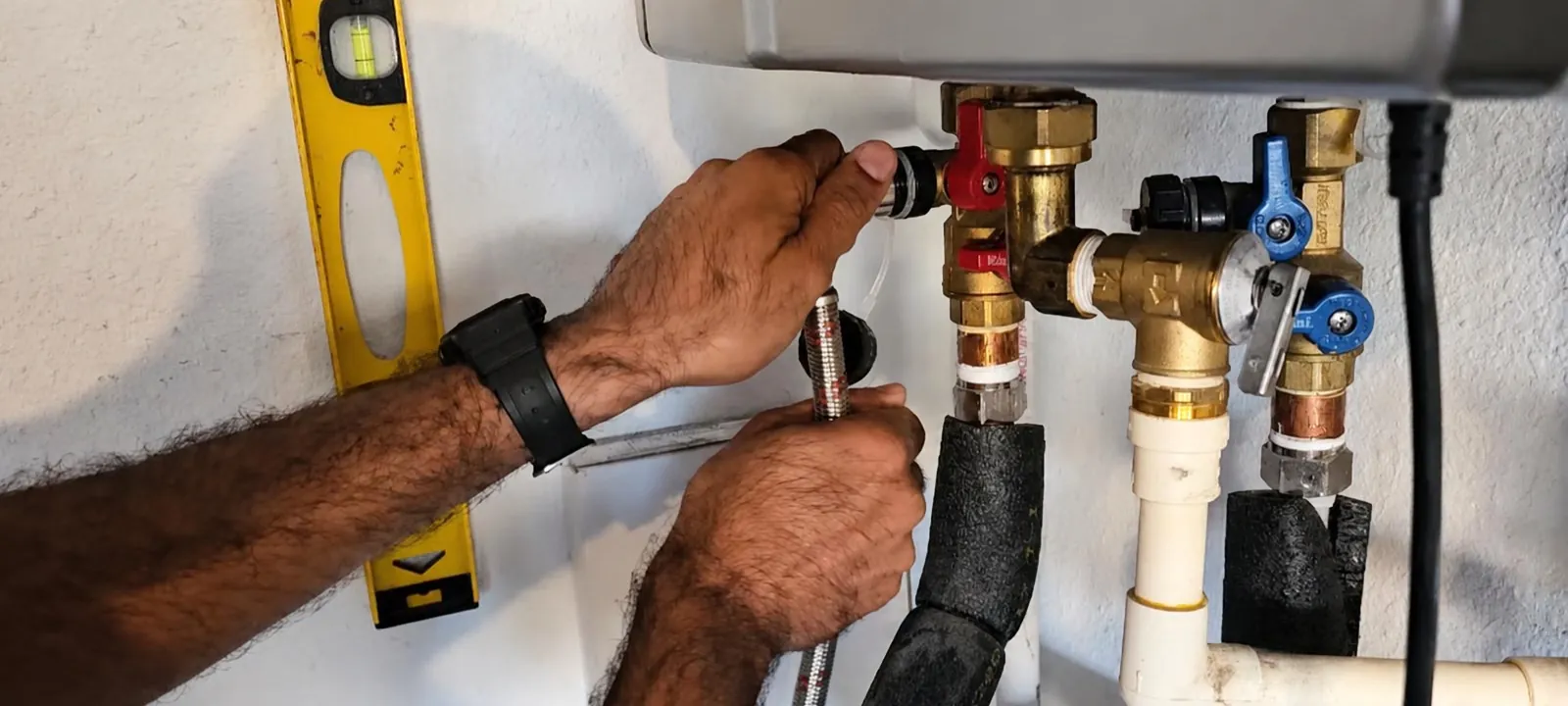
A tankless water heater flush pushes a descaling solution through the unit to dissolve the mineral scale that builds up inside the heat exchanger. Left alone, that scale narrows the passages, so the heater works harder, makes less hot water, and throws error codes.
Cost depends on the unit, the access, and how much scale there is, so this page explains how the price is built instead of quoting numbers. It also covers timing, meaning how often to flush and how long a visit should take, plus the signs a flush is due and the line between a safe DIY job and a call to a plumber.
What scale does inside a tankless unit
Hot water pulls dissolved minerals out of solution, and they stick to the hottest surface. In a tankless heater, that surface is the heat exchanger, where the water passes through narrow channels at high temperature. A thin crust there changes how heat moves and how much water gets through.
Many units respond by firing harder or cutting flow, which can speed the scaling, and when the sensors trip the unit reports a fault or shuts down. That is the moment most owners learn that these heaters have maintenance.
Signs your unit wants attention
Scale rarely announces itself with one dramatic failure. It shows up as small changes that worsen gradually.
- Water that never gets quite as hot as before, or swings between hot and lukewarm.
- A drop in flow at the shower while the cold side stays strong.
- Rumbling, popping, or kettle-like sounds from the unit as it fires.
- Error codes that point to overheating, flow, or ignition, as listed in your manual.
- White or tan flakes in the faucet aerators or inlet filter screen.
These also fit other problems, such as a clogged inlet screen, a failing sensor, or a gas supply that is too small. A flush is the first thing to rule out, not the only thing to check.
Flush by yourself or hire it out?
The process is simple in outline, but the details vary by maker, so your manual's steps are the ones that count. The rough order is below, and every line should be checked against the manual for your model.
Isolate the unit
Power off, gas off on a gas model, and let the unit cool. Then close its isolation valves.
Connect hoses at the service ports
Hook the pump and hoses to the service valve ports, with the discharge hose secured in a bucket.
Circulate the solution
Run it for the time your manual states, since the maker sets that, not a rule of thumb.
Flush with clear water
Rinse the unit through, then clean the inlet filter screen.
Reopen slowly and check
Open valves gradually, look for drips, then confirm hot water and no error code.
Before you open any valve
Hot water scalds and descaling solution irritates skin and eyes. Let the unit cool, wear gloves and eye protection, and work in a ventilated space.
- Cut power to the unit at the breaker.
- Close the gas supply on a gas model.
- Never use a flame or spark near the unit.
| Factor | Do it yourself | Call a plumber |
|---|---|---|
| Valves | Unit has service valves and they turn freely | Valves missing, stuck, or leaking |
| Fuel | Electric unit, power fully off | Gas unit where you would touch gas or vent parts |
| Equipment | You already own a pump, hoses, and solution | You would have to buy or improvise tools |
| Condition | Mild symptoms, steady performance | Error codes, leaking, or water damage near the unit |
| Aftercare | You can check the inlet filter and test flow | You want the unit inspected for ignition and venting |
Two rules apply to anyone doing this. Turn off power and, on a gas unit, the gas supply before touching anything. And never mix the descaling solution with other chemicals, and dispose of used solution as the product label directs.
Hot water from the unit and the solution can both scald, so relieve pressure slowly. Stop and call a plumber if a valve will not turn, anything leaks, or a gas smell appears. On a gas model, the gas valve, the vent, and any relight are plumber work unless your manual clearly says otherwise.
What shapes the price of a professional flush
Several things change what a visit costs, and none of them can be known without knowing the unit. That is why we ask about the unit and where it sits before giving a clear price before work starts.
- Whether the unit already has service valves or the plumber must add them first.
- How hard it is to reach the unit, such as a tight closet or a high wall.
- How scaled the exchanger is, since a bad one may need a longer circulation time.
- Whether the visit also covers cleaning the inlet filter and checking venting and gas connections.
- Whether the unit has a condition beyond scale that needs repair.
Visit length follows the same factors. A unit with valves already fitted and easy access takes less time than one that needs valves added or sits in a tight closet. Rather than expect a fixed number, ask the plumber how long your visit should take, whether the circulation time depends on the scale, and whether the unit needs a second look afterward.
A clear price before work starts is the right standard for any of these. If a unit is badly scaled and still fails after a flush, the next step is usually the water heater repair side of the job.
What a flush will not fix
A flush clears scale. It does not repair a cracked heat exchanger, a failed fan, a bad flame sensor, or a gas line that is too small for the unit. If the same code returns within days of a clean flush, scale was not the main problem.
Cold water sandwiches, where hot water briefly runs cold between two hot bursts, come from the way the unit and the household use water. A flush will not change that. A plumber can check flow settings and the recirculation setup instead.
How often should it be done?
There is no honest single interval. Follow the maker's schedule, then shorten it if your water leaves scale quickly. Some owners flush yearly, others less often, and the right call depends on how hard your water is and how much hot water the household uses.
A simple habit helps. Check the inlet filter screen when you notice any dip in flow, and note the date of each flush on the unit. If you are choosing a new heater and want to weigh maintenance, the tankless water heater page explains what ownership involves.
If a plumber adds service valves or changes anything on the water or gas side, ask which edition of the International Plumbing Code (IPC) or International Residential Code the work follows. Alabama's plumbing board rule 720-X-1-.02 names the 2021 editions, and the board can tell you the current one.
Homes in Alabaster and Helena are served by different water utilities than Pelham Water Works, so the same schedule can fit them differently, and we serve both towns. A short test of your own tap tells you more than a rule of thumb.
Not sure it is scale?
Call the 24/7 line and describe the symptoms and any error code. The dispatcher can help you judge whether a flush is the right first step.
What Pelham Water Works says about your water
The Pelham Water Works 2024 water quality report says supply comes from five wells plus purchased water from Shelby County Water Services. Because the mix differs between streets, do not assume your neighbor's flush schedule fits your unit. Test your own tap with a simple kit and share the result with the plumber.
The same report lists a wide range for total hardness and prints no unit, so treat it as a sign of variation rather than a number to plug into a formula. Pick a flush interval from the maker's schedule and your own tap, then shorten it if you see flakes on the faucet aerators.
The report also gives pH 7.3 and calls the water non-corrosive. That speaks to pipe corrosion, not scale, so check your aerators and the heater's inlet filter on the same schedule as the flush.
Source: Pelham Water Works 2024 Annual Drinking Water Quality Report.
Tankless flush questions answered
It depends on whether service valves are installed, how reachable the unit is, how much scale is inside, and what the plumber is asked to include. We do not publish numbers here, and we give a clear price before work starts when you call. Ask what the visit covers so you can compare quotes fairly.
Some makers allow food-grade vinegar and others specify their own solution. Use what your manual says, since the wrong acid can harm seals.
Sometimes. Codes tied to overheating or low flow often improve after scale is cleared. A code for ignition or a sensor can have a different cause and may need repair.
On a gas unit, closing and reopening the gas valve and any relight is gas work, so we suggest a plumber do it unless your manual explicitly walks you through it. If you smell gas at any point, leave the house and call your gas utility or 911 from outside.
Scale builds before you notice. Check the maker's schedule first, then look at your aerators and the inlet filter. If you find flakes, flush sooner.
Pelham Water Works lists a wide hardness range in its report, and its sources are a mix of wells and purchased water. That means streets can differ. Test your tap and tell the plumber what you find.