
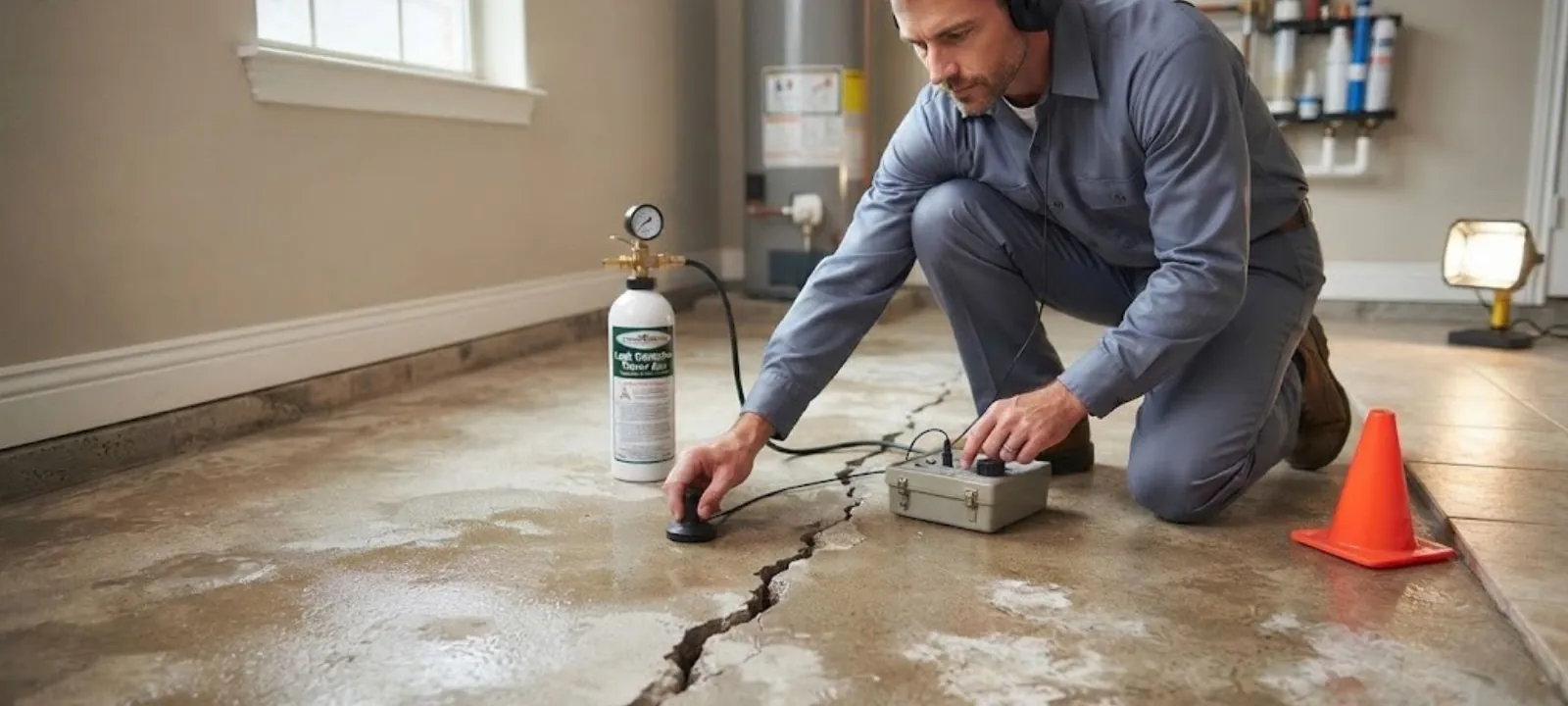
A slab leak is a leak in a water line that runs under or inside a concrete slab foundation. Because the pipe is buried in or beneath the concrete, you rarely see the water until it has been running a while. Many homeowners notice the bill first. This guide covers how the leak shows itself, how a plumber finds the exact spot, and what the repair choices really involve.
It applies only if your home is built on a concrete slab, or has a slab section such as an addition or a garage. If you are not sure what is under your floor, a plumber can tell you in a short visit, and the answer matters before you plan a repair.
What a leak under the floor tends to look like
The symptoms overlap with other problems, so look for a pattern rather than a single clue. Warm spots on a floor that are not near a heater suggest a leak on the hot line. Damp or discolored carpet along a wall, a musty smell, or lifting flooring edges are other signs.
- A faint hissing or running sound when every tap is off
- A water meter dial that keeps moving with all fixtures closed
- Hot water that arrives lukewarm or takes much longer than usual
- Low pressure at several taps that is new
- A jump in the water bill with no change in how you use water
Any one of these has other explanations, such as a running toilet or a failing water heater. Several together make a slab leak much more likely.
Rule out the easy suspects, then confirm
Start with the meter. Turn off every fixture and appliance, find your water meter, and watch the small low-flow dial or leak indicator for a few minutes. If it spins, water is escaping somewhere past the meter. Next, close the main shutoff valve at the house and check again.
Before you trust the dial, check for outdoor sprinklers, an ice maker or a softener that may be using water, and rule them out first. If you cannot find the main shutoff valve, call the 24/7 line and the dispatcher will talk you through finding it.
If the dial stops after you close the main, the leak is inside your home's plumbing. If it keeps moving with the main closed, the leak may be on the stretch between the meter and your house. A plumber can help you tell which side of the house the leak is on. Confirm the boundary with Pelham Water Works at (205) 620-6420 and ask who is responsible for that stretch of pipe before you pay for work.
How a plumber finds the spot without demolition
Breaking up concrete on a hunch is a poor way to find a leak. Modern pinpointing uses tools that sense what the pipe is doing. Acoustic listening equipment picks up the sound of water escaping through a small hole, thermal cameras show warm patches on hot line breaks, and pressure testing isolates which section of the system is losing water.
For a hot line, a thermal scan can map the route the pipe takes under the floor. Combined with listening, these tools can often narrow the leak to a small area. Ask the plumber to confirm the location before anyone cuts the slab, so the opening stays as small as the job needs. See leak detection for how that works.
Common ways to fix a leak under the slab
Which repair fits depends on how many leaks there are, how old and what type the pipe is, and what the floor above is made of. A plumber should lay out the options and say why one fits your house. Pipe lining is another option some trades offer, so ask whether it applies.
| Option | What it involves | Best when | Trade-off |
|---|---|---|---|
| Spot repair through the slab | Cut a small opening in the floor and concrete, then fix or replace the damaged section | One clear leak in pipe that is otherwise sound | Floor covering and concrete need patching, and other leaks may follow |
| Reroute the line | Abandon the leaking run and install new pipe through walls or the attic | Leak is in a hard-to-reach spot or the run is aging | More pipe work, but little or no concrete cutting |
| Repipe the system | Replace the supply plumbing with new pipe | Repeated leaks or pipe nearing the end of its life | Largest job, but it resolves the pattern |
Rerouting can be simpler than it sounds, since new lines in the walls or ceiling are easy to reach later. If you are weighing it against a bigger replacement, the repiping page explains how that decision is made. Repiping and slab work fall under the plumbing code, and the Alabama Plumbers and Gas Fitters Examining Board rule 720-X-1-.02 names the 2021 International Residential Code for residential work, so check the board for the current edition.
Paperwork that helps you later
Photograph the damp area, the meter reading, and the repair opening before anything is closed up. Keep the plumber's written report and invoice. Ask your insurer what your policy covers before work starts, and keep photos and the plumber's invoice.
Do not wait for approval if water is actively escaping. Shutting off the main valve is the usual first step. If it will not turn, do not force it, and call a plumber. If water is near outlets or the panel, stay clear and switch off power only if you can reach the panel from dry footing. For an active leak or a bill that keeps climbing, call the 24/7 line and a plumber can start with detection.
Serving homes beyond Pelham
Slab leaks do not stop at the town line, so the same steps apply in Alabaster and Helena. Pelham Pro Plumbing serves Pelham and nearby towns, with same-day appointments when available.
Pelham water bills, leak adjustments, and ground that moves
Pelham Water Works has a leak adjustment policy, and a leak under a slab is the kind of hidden leak it was written for, though the city decides eligibility. According to the city's policy page, it looks at whether your usage ran above 1.5 times the average of the preceding three billing cycles, and that the leak was not readily detectable. This is policy at time of writing, so confirm current terms with Pelham Water Works at (205) 620-6420.
If the bill is your concern, water meter leak detection has the full explanation. Keep the plumber's invoice and take photos the day the work is done, since the paperwork is due within 60 days after the repair. Pay the bill on time, because the account must be paid in full, and do not delay the repair.
A wet spot or sunken patch in a yard is not always plumbing. The Shelby County Reporter says limestone bedrock underlies much of Shelby County, and in 2014 a sinkhole opened on Cambrian Ridge Drive in Pelham after heavy flooding. A bowl-shaped dip or leaning trees near a structure should be reported to the police, who alert Public Works, rather than dug up by you. Call 811 before any digging.
Source: City of Pelham leak adjustment policy page, and Shelby County Reporter, April 29, 2014, coverage of the Pelham sinkhole.
Slab leak questions answered
Look for warm floor spots, the sound of running water when everything is off, a meter that moves with all fixtures closed, or a bill that jumped without a reason. One sign is a hint. Two or three together are worth a professional check.
Often yes. Pinpointing first keeps the opening small, and rerouting the line through walls avoids cutting the slab at all. The right choice depends on the pipe, the leak count, and the floor finish.
It varies by policy. Ask your insurer what your policy covers before work begins, and keep photos and the plumber's invoice.
Not long. A leak that keeps running can damage flooring, walls and the soil around the slab, and it adds to your bill every day. How fast depends on the size of the leak.
Close the main valve when you are away and book detection promptly.
Look for a crawlspace door or basement stairs. If there is neither, your home may be on a slab. Ask a plumber, or check any inspection report or plans you have.
Possibly. At the time of writing, Pelham Water Works has a leak adjustment policy for leaks that were not readily detectable, and it asks for paperwork within 60 days after the repair. It also looks at whether usage ran above 1.5 times your recent average. Confirm current terms with Pelham Water Works.