
A sewer line problem usually shows up in the lowest drains first. A tub that gurgles when the washer drains, a toilet that bubbles, or a floor drain that holds water all point past the fixture and into the pipe that carries everything out of the house. This guide covers what those signs mean, whose pipe is at fault, and what happens next.
The first hour of a backup
Treat standing sewage as a health hazard
Sewage carries bacteria. Keep children and pets out of the area and wear rubber boots and gloves. If water is touching outlets, cords or the panel, stay out and call 911 or your electric utility if there is any shock risk. Switch off power at the breaker only if the panel is dry and you can reach it without stepping in water. Then call the 24/7 line for the plumbing.
- Stop flushing, doing laundry, running the dishwasher, and showering
- Close the toilet lids and the tub drains to slow the spread
- Do not pour drain cleaner into a backed-up line. It sits in the pipe and burns whoever opens it
- Do not open the cleanout cap yourself. A backed-up line can surge and release sewer gas
- Move rugs and stored boxes off the floor around the lowest drain
- Note which fixtures were affected, since the order helps locate the blockage
Every gallon you send down a blocked line has nowhere to go but the lowest opening in the house. That is why stopping water use matters more than any cleanup in those first minutes. A plumber can open a cleanout safely and relieve the pressure, which usually stops the overflow.
Your pipe or the city's pipe
A house on public sewer has a lateral, the pipe that runs from the foundation out to the sewer main. If you are not sure your address is on city sewer, ask Pelham Water Works at (205) 620-6420. The main is the larger public pipe, usually under the street or in an easement. Roots, sags, and worn joints are common trouble spots in the lateral.
Count how many properties are affected. If only your house backs up, suspect the lateral or the house drain. If neighbors have the same problem, the main may be involved and the utility needs a call right away. Where the city's responsibility starts depends on the property, so confirm the boundary with Pelham Water Works at (205) 620-6420 instead of guessing.
A sewer inspection shows where the damage is. The recording gives you something concrete to show the utility, which decides who is responsible for which section.
Reading the symptoms
| What you see | Likely cause | Next step |
|---|---|---|
| Tub or shower gurgles when a toilet flushes | Partial blockage in the main drain, or a blocked vent | Limit water use and have the main line cleared and scoped |
| Every drain is slow at once | Blockage in the main drain or the lateral | Stop using water and call a plumber |
| Floor drain or lowest tub backs up when the washer runs | Stoppage downstream of the branch lines | Turn off the washer and keep drains closed until it is cleared |
| Sewage smell outside, or one unusually green, soggy patch | Cracked or separated pipe leaking into the soil | Camera the line and locate the break before digging |
| A dip or bowl-shaped sag in the yard | Soil washing into a broken pipe, or ground settling | Keep people and mowers off and get it checked |
| Clogs return every few months | Roots or a low spot in the pipe that holds water | Camera first, then decide between cleaning and repair |
What a camera inspection shows
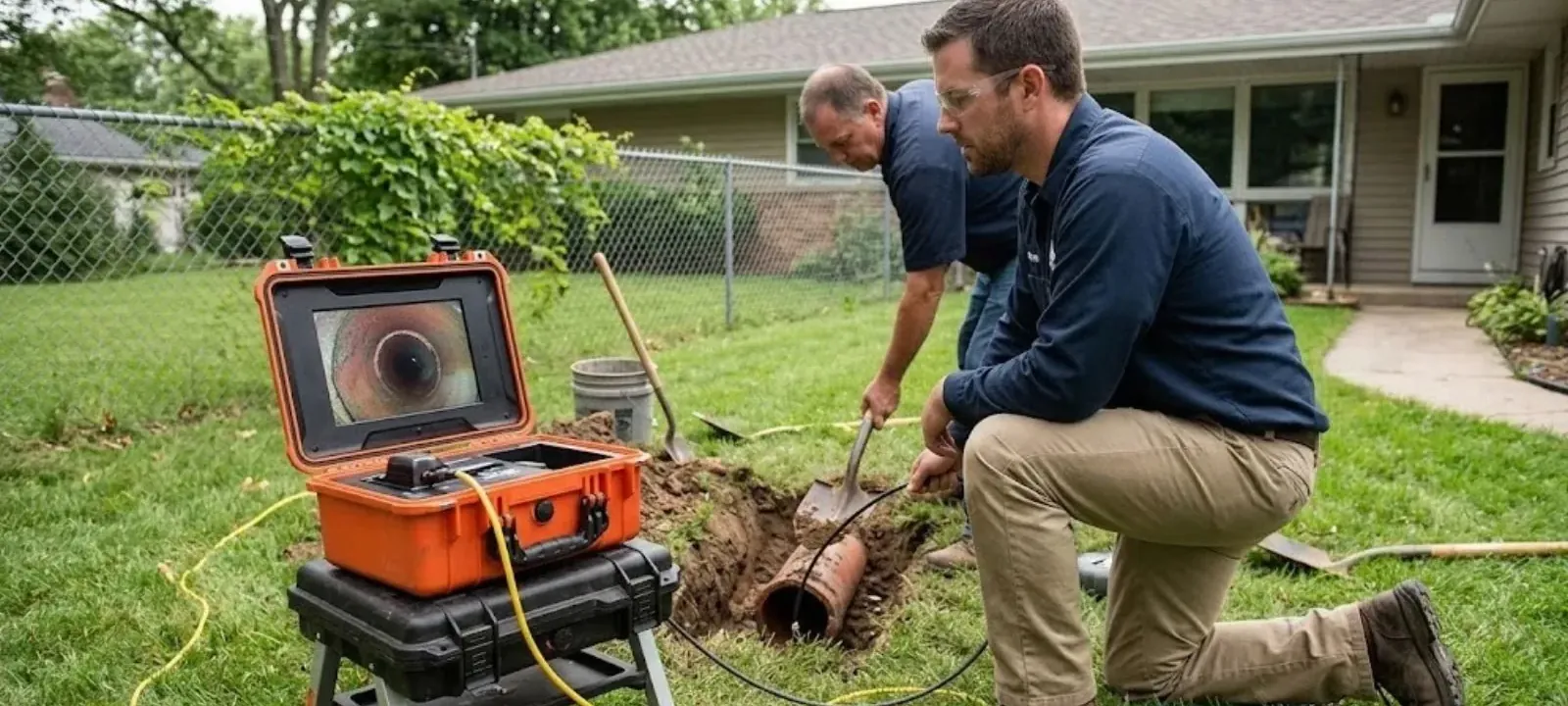
A plumber can feed a small waterproof camera on a flexible rod through a cleanout, or through a pulled toilet if there is none. The screen shows the inside of the pipe in real time. A plumber can read roots, offset joints, grease buildup, cracks, and sections that sag and hold water.
Many camera heads carry a locator that sends a signal to a receiver above ground, so the spot and depth of a defect can be marked on the lawn or driveway. That can turn a repair into a small dig instead of a long trench. Ask whether a recording of the inspection is available, since it helps when you describe the problem to your insurer or the utility.
Repair paths from least to most digging
Options generally include spot repair, lining, and full replacement. Cleaning removes a blockage but does not fix a broken pipe. If the camera finds roots in a sound pipe, cutting them out may hold for a while. If it finds a crack or a bellied section, the same clog returns.
- Spot repair. The plumber digs to the defect and replaces that section, which suits one isolated break.
- Lining. A resin-saturated sleeve is cured inside the old pipe, which works when the pipe is still roughly round and continuous.
- Full replacement. Trenching or pipe bursting swaps the whole lateral when the damage runs along its length.
What the work costs depends on depth, length, what sits on top of the pipe (a driveway, a tree, a patio), and how much of the line is damaged. A plumber can give you a clear price before work starts once the camera shows the problem. Our sewer line repair page explains these options in more detail.
Whichever route you take, call 811 before any digging. Buried lines of every kind run through residential lots, and the locate request is the standard first step before breaking ground.
Keeping the line from backing up again
Grease poured down a kitchen drain cools and coats the pipe wall. Wipes sold as flushable, paper towels, and hygiene products catch on rough joints and roots. Put grease in a can for the trash, keep wipes out of toilets, and note where large trees sit near the line.
Sewer work is governed by plumbing code. Alabama's plumbing board rule 720-X-1-.02 names the 2021 International Plumbing Code (IPC) for commercial plumbing and the 2021 International Residential Code for homes, so ask the plumber which edition a repair follows, and check the board for the current one.
What to tell the city and your insurer
Give Pelham Water Works the date, the time, and the fixtures affected. Say whether neighbors have the same problem, and offer the inspection video if you have it. That information helps the utility decide whether to look at the main.
Ask your insurer what your policy covers before you assume a backup is covered, and keep photos and the plumber's invoice.
Backups in Alabaster and Helena raise the same two questions: is it my pipe, and can it wait. We serve both towns, and you can read about them on the Alabaster plumber page and the Helena plumber page. Rising or entering sewage cannot wait. A slow drain with no overflow can often wait for a same-day appointment when available.
Sewage backing up or drains gurgling?
Stop using water, then call the 24/7 line and describe which fixtures are affected. The dispatcher can send a licensed plumber.
Pelham's sewer system and the ground under it
Pelham Water Works, part of City of Pelham Public Works, provides both water and sewer service. If you suspect the main, call them at (205) 620-6420 and describe what you see. The city's sewer department says it meets or exceeds ADEM and EPA standards, which describes the public system and not your private lateral, so a camera is still how you learn about your own line.
In 2014, after heavy flooding in April, a sinkhole opened on Cambrian Ridge Drive in Pelham. The void was about 4 feet wide and 22 feet deep, and the Shelby County Reporter noted that limestone bedrock underlies much of Shelby County. The Reporter listed bowl-shaped depressions, leaning trees, and road dips that hold water as signs of a sinkhole.
If you see a bowl-shaped dip, a leaning tree, or a low spot that holds water and keeps growing, keep people off it. If it is near a road or a building, call the police, who alert Public Works. Do not assume the cause is your sewer line, and do not dig it out yourself.
Pelham considers a sewer adjustment only when a water adjustment is approved first, and paperwork is due within 60 days after a repair, so keep the plumber's invoice and photos. That is policy at time of writing, so confirm current terms with Pelham Water Works. The full rules for qualifying leaks are on the water meter leak detection page.
Source: City of Pelham Water Works and sewer department pages, and the Shelby County Reporter, April 29, 2014.
Sewer line questions we hear most
Check whether neighbors are affected and which fixtures back up. A problem that touches only your house usually sits in your lateral or house drain.
A camera inspection settles it. If the blockage is past your property line, the recording tells the utility where to look.
Yes, often. The plumber pulls the toilet, feeds the camera down the closet bend, and sets the toilet again with a new seal.
A cleanout added during repair makes later inspections easier.
If the pipe has an open joint, roots will return because the joint is still an entry point. Cutting them out buys time and does not close the opening.
Lining or replacing the damaged section is what ends the cycle.
Yes when sewage is rising or entering living space. Stop using water and call the 24/7 line. If sewage is near outlets or the panel, stay out and call 911 or your electric utility if there is any shock risk.
A slow drain with no overflow can usually wait for a same-day appointment when available.
Policies differ, so ask your insurer what yours covers before the work starts.
Keep photos and the plumber's invoice either way.
Call Pelham Water Works at (205) 620-6420. Tell them your address, which fixtures are affected, and whether neighbors see the same thing.
If sewage is rising in your home, stop using water first and then call a plumber to relieve the line.