
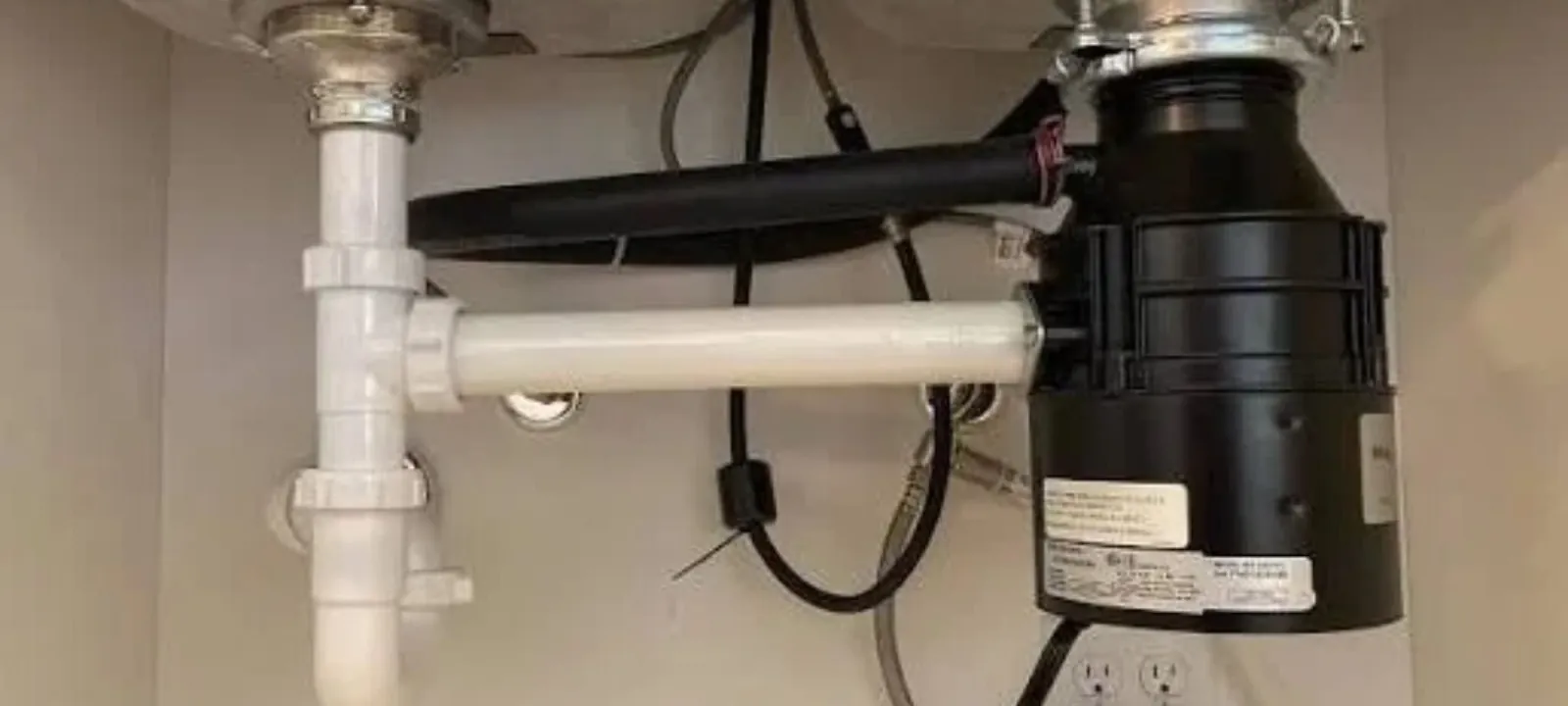
A garbage disposal needs a switch, and the switch is the part that makes this job tricky. Mounting a disposal, hooking up its drain, and testing for leaks is plumbing. Running power to a new switch, cutting into a wall, or changing a circuit is electrical work. Pelham Pro Plumbing dispatches licensed plumbers, and the wiring half of this job goes to an electrician, so this guide shows where the line falls.
Where plumbing ends and electrical begins
The plumber's side is everything that touches water. That means setting the disposal under the sink, connecting it to the sink flange, attaching the drain trap, and linking the dishwasher hose. It also means checking every joint for drips after the first run.
The electrician's side is anything that carries household power to the switch. That includes running new cable through a wall, installing a wall box, and tying into a circuit. If the disposal is wired straight into a junction box, any change to that connection is electrical work too. Doing it wrong risks shock and fire.
Wall switch or air switch
| Wall switch | Air switch | |
|---|---|---|
| How it works | Standard switch on a wall, wired to the disposal or an outlet | Countertop button pushes air through a small tube to a module under the sink |
| Wiring needed | New cable and a wall box if none exists | Module plugs into an outlet and the disposal plugs into the module |
| Who does it | An electrician is the usual choice | Many homeowners, if the disposal already has a plug |
| Counter or sink work | None | A small hole in the countertop or sink deck |
| Best fit | Kitchens that already have a spare switch, or new remodels | Kitchens where running wire is hard |
A wall switch is the traditional choice and it keeps the countertop clear. An air switch avoids the wiring, which is why it appeals when the wall is tile, finished, or hard to open.
How an air switch is put together
An air switch has three parts. The button sits on the countertop or sink deck. A thin hollow tube runs from the button down to a control module beneath the sink. When you press the button, a puff of air travels down the tube and trips a contact inside the module.
The module has a cord that plugs into an outlet under the sink, and it has its own outlet for the disposal's cord. No wire has to be fished through a wall. The catch is that the disposal needs a plug, and many are hardwired directly into the house wiring. Converting a hardwired disposal to a plug is electrical work, so it falls to an electrician.
Mounting the button takes a hole in the countertop or the sink deck. Stainless sinks often have a knockout or a spare faucet hole you can use. Drilling stone, quartz, or solid-surface counters is a different matter.
A cracked countertop is a bigger problem than a missing switch, so many homeowners leave that step to a pro. If a faucet is being swapped or fixed anyway, the deck is already open, so a plumber doing faucet repair can tell you whether a spare hole exists for the button.
An air switch is simple, but it has limits. If an existing wall switch controls the outlet under the sink, the module must plug into an outlet that stays powered, or the button will do nothing. Tubes have a maximum length, units differ, and the instructions that came with the switch are the authority on mounting and plug-in order.
Switch off the breaker
Turn off the breaker for the outlet under the sink and confirm it is dead with a non-contact tester before you reach into the cabinet.
Make the button hole
Use the spare hole in the sink deck or a hole drilled in the counter, and seat the button the way the instructions say.
Run the tube
Feed the air tube down to the module under the sink without kinking it.
Plug in the module
Plug the module into an always-powered outlet, then plug the disposal into the module. Keep the cabinet floor dry.
Restore power and test
Switch the breaker back on, run cold water, press the button, and check the disposal and its drain for leaks.
Power off before you touch anything
Electricity and a wet sink cabinet do not mix
Switching a disposal off with the wall switch does not cut power to it. Shut off the breaker first, then press the switch to confirm the disposal is dead, and never reach in by hand.
- Switch off the breaker that feeds the outlet or junction box, then confirm with a non-contact voltage tester
- Unplug the disposal if it has a cord, only after the breaker is off and only from dry footing
- If the cabinet floor is wet or the disposal has been leaking, do not touch it and do not stand in water to reach the panel. Keep water away from outlets, call the 24/7 line, and have the leak stopped first
- Never reach into the disposal by hand, even when it is off. Use a wrench on the hex socket underneath or tongs from above
- If you are not sure which breaker feeds the disposal, stop and call an electrician
Kitchen outlets near a sink are often GFCI protected, and a tripping breaker is a sign that something is wrong. Do not defeat the protection to make the disposal run. The disposal's manual and an electrician can tell you what your circuit needs.
Disposal installs also fall under plumbing code. Alabama Plumbers and Gas Fitters Examining Board rule 720-X-1-.02 names the 2021 International Residential Code for residential plumbing, so check the board for the current edition.
Who to call for which job
Most homeowners hire an electrician for a new wall switch, a new circuit, a cable run, or converting a hardwired disposal to a plug. Call a plumber to install or replace the disposal itself, fix a leaking flange, or sort out a drain that backs up when the disposal runs. For the plumbing half, see garbage disposal repair and installation, and leave the switch circuit to a licensed electrician.
Before you book either trade, write down a few details. Note whether the disposal has a cord or is hardwired, which breaker feeds it, where the button or switch should sit, and whether the sink is stainless, stone, or solid surface. Those four answers let the person on the phone tell you what the job involves.
If your disposal hums and does not spin, that is usually a jam or a tripped reset button on the bottom of the unit. A switch swap will not fix it. A plumber can free the jam, test the motor, and tell you whether it is worth repairing.
If you live in Alabaster or Helena, the job divides the same way. The Alabaster plumber page and the Helena plumber page describe how a plumber is dispatched to each town.
Keep the disposal alive once the switch works
Run cold water before, during, and after grinding. Feed small amounts of food scraps at a time. Skip grease, bones, fibrous peels, coffee grounds in bulk, and pasta or rice that swell. A disposal that clogs the drain line is a plumbing call, not a switch problem.
Permits and the sewer in Pelham
Permit rules vary by job, so ask the Pelham Building Department at 205.620.6495 before you start any electrical or plumbing change. The office is at 3162 Pelham Pkwy and is open Monday to Friday, 7:30 to 4:30. A quick call before you buy parts can save you from redoing work.
If your home is on city sewer, what a disposal grinds goes to a system Pelham Water Works runs along with the city's water. If you are on a septic tank instead, ask a septic service before you add or upgrade a disposal. Keep grease out of the drain either way, and if your kitchen drain slows after the disposal runs, stop feeding it and have the line checked.
Source: City of Pelham Building Department and Pelham Water Works pages.
Disposal switch questions
An air switch is a realistic do-it-yourself job if the disposal has a plug and you can drill the button hole safely. A wall switch means wiring, which is electrical work.
If you are unsure, hire a licensed electrician for the switch.
Pelham Pro Plumbing dispatches licensed plumbers for the disposal itself. Wiring a wall switch is electrical work, and most homeowners hire an electrician for it.
Check with whoever you hire whether they will plug in an air switch module. If the disposal already has a plug, it is a plug-in job, but some trades will leave it to an electrician.
Yes, because the button carries air and not electricity. The module under the sink does carry power, so keep it dry and off the cabinet floor.
Use only a unit made for disposals.
Often the blades are jammed. Turn off the breaker, turn the hex socket under the unit with a wrench, then press the reset button.
If a wrench in the hex socket does not free it, or there is no hex socket, stop and have a plumber look. If it keeps tripping, the motor may be failing.
The disposal has to accept a plug. Converting it is electrical work and needs an electrician.
A new disposal with a cord solves it.
Permit rules vary by job. Ask the Pelham Building Department at 205.620.6495 before you begin.
Have the make and wiring of the disposal in hand when you call, so the office can tell you what applies.