
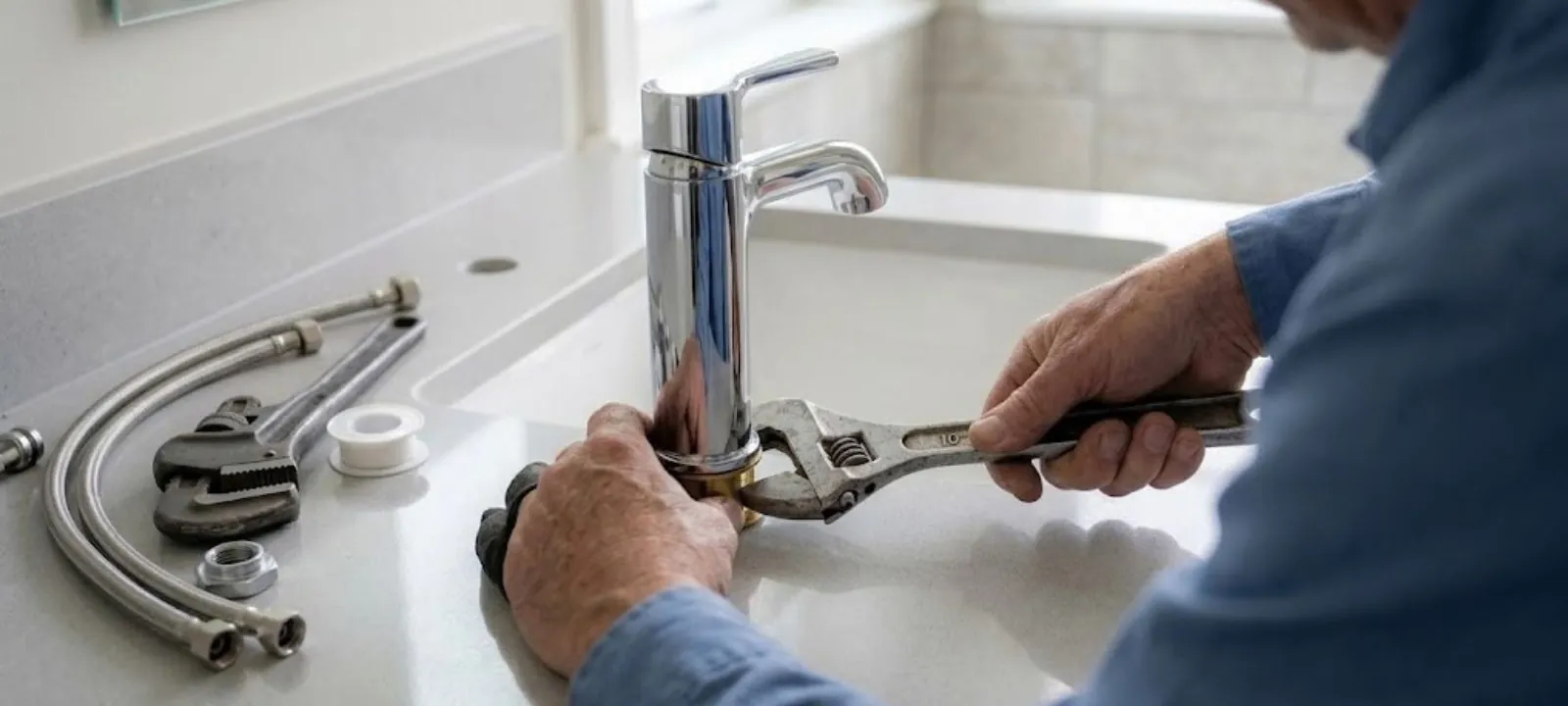
A bathroom faucet fails in a handful of predictable ways. It drips from the spout, leaks around the handle, sprays sideways, or runs weak. Each of those points to a different small part, and most can be handled with a screwdriver, an adjustable wrench, and some patience. The first job is to work out which kind of faucet you have, because that decides the fix.
Work out which faucet you own
Look at the handles. A single lever or one round knob that moves in several directions is usually a cartridge or ball style faucet. Two separate handles generally mean either compression stems, which close against a rubber washer, or two ceramic disc cartridges that turn a quarter or half turn.
If the handle keeps turning and feels firmer the harder you push, it is probably a compression faucet with a washer. If it turns smoothly with no resistance and stops abruptly, it is likely a ceramic disc cartridge. Photograph the faucet before you start, since brand names are often hidden under a cap.
Prepare so the repair stays small
Close both oval stop valves under the sink by turning them clockwise until snug. Open the faucet to drain the lines. Stop the drain with a rag or the pop-up, lay a towel in the basin, and set aside a small cup for screws.
If a stop valve will not turn or drips when you close it, do not force it. An old stop that cracks can flood the cabinet. In that case, shut the whole house off at the main and let a plumber replace the stop along with the repair.
Fixing a drip at the spout
A steady drip means water is passing a worn seal. On a compression faucet the culprit is the rubber washer or the brass seat it presses against. On a cartridge faucet it is the cartridge itself or the rubber seals around it.
Pry off the decorative cap, remove the handle screw, and lift the handle away. Unscrew the stem or pull the cartridge, noting its orientation. Replace the washer and seat, or the whole cartridge. A worn seat can be dressed with a seat tool, but a pitted one is easier to replace than to keep resurfacing. Note the faucet's model, the cartridge shape and the number of splines, or take photos, before buying a replacement.
Leaks around the handle or base
Water seeping beneath the handle when the tap is on is a sign of a dry or cut O-ring on the stem or cartridge. Rolling a new O-ring on, with a thin coat of plumber's grease, usually stops it. Check also that the packing nut at the base is snug, not cranked down.
If water collects at the base of the spout, the O-rings in the swivel joint are suspect, which is common on a faucet with a swivel spout. Remove the spout, replace the rings, and lightly grease them before it goes back on.
Low flow and spray problems
If the faucet runs weakly, first unscrew the aerator at the tip of the spout. It holds a small screen that catches grit and mineral flakes, and it clogs more often than anything else. Soak the screen in white vinegar for an hour, brush it clean, and reinstall.
If weak flow persists after the aerator is clean, check the flexible supply lines and the stops for kinks or partial closures. If only the hot side is weak, a sediment flake may have lodged in the cartridge, so remove and rinse it.
Repair or replace: a quick decision guide
| Situation | Repair makes sense | Replace is smarter |
|---|---|---|
| Drip from a young faucet | New cartridge or washer is available | Parts are discontinued or the body is pitted |
| Handle looseness or wobble | Tightening or replacing the handle set | Corroded mounting or cracked base |
| Weak flow | Cleaning the aerator and supply lines | Mineral buildup inside the body |
| Older faucet that keeps needing fixes | Only if each fix is minor | New supply lines and a new faucet body, instead of another round of small fixes |
| Leaking supply lines or stops | Swap the line or valve | Replace faucet, lines and stops together |
If the same faucet keeps needing repairs, replacing it often costs less trouble than another round of parts. A plumber doing plumbing installation can fit a new faucet, supply lines, and stops together so the entire connection is renewed, and a visit for faucet repair can help you decide which side of that line you are on.
Supply lines and stops while you are under there
Once the cabinet is open, look at the two braided supply lines running from the stops to the faucet. Press a dry paper towel along each connection. A damp towel means a weeping nut or a worn washer, and tightening a quarter turn often fixes it. Braided lines that are kinked, rusty at the nut, or bulging should simply be replaced.
Putting it back together and testing
Reassemble in reverse
Refit the cartridge or stem in the same orientation, then the handle, screw and cap. Do not over-tighten.
Turn the stops on slowly
Open each stop a little at a time so the lines fill without a surge.
Flush with the aerator off
Let water run for a minute with the aerator removed to clear debris, then reinstall the aerator.
Check every connection
Press a dry paper towel on each joint under the sink and look again after ten minutes. If any joint is damp, shut the stops and recheck the fit.
If a handle will not come off, do not pry hard. A little vinegar around the screw or set screw can free mineral buildup, and if it still holds, that is a good time to call a plumber. Faucet and stop work falls under the plumbing code, so check the Alabama Plumbers and Gas Fitters Examining Board for the current edition of the International Residential Code it names in rule 720-X-1-.02.
Safety and limits
Stop work and call for help if the shutoff valve will not close, if the wall is wet behind the vanity, or if the drain pipe leaks as well as the faucet. Do not try to fix a leak that runs inside the wall. Call the 24/7 line for active water you cannot stop.
Alabaster and Helena homes are within reach too. Pelham Pro Plumbing sends licensed plumbers with a clear price before work starts, and the Alabaster and Helena pages explain how.
Pelham water, aerators, and your water bill
The Pelham Water Works 2024 water quality report lists a wide hardness range, and the city mixes well water with purchased water. Mineral content can differ by street, so one street may see more buildup in aerators than another. If your bathroom flow drops every few months, check the aerator first and soak it in vinegar before assuming the faucet is failing.
At the time of writing, the Water Works leak adjustment policy excludes dripping faucets, leaking toilets, and fixtures left running. A faucet drip will not earn a bill credit, so repair it promptly instead of waiting. Confirm current terms with Pelham Water Works at (205) 620-6420.
Permit rules vary by job, so before you swap a stop valve or move supply plumbing, ask the Pelham Building Department at 205.620.6495.
Source: Pelham Water Works 2024 Annual Drinking Water Quality Report, City of Pelham leak adjustment policy page, and the City of Pelham Building Department.
Bathroom faucet repair questions
A worn washer, seat, or cartridge is letting water slip past the closed position. Replacing that part usually ends it. If the drip returns quickly, the valve seat is likely pitted.
It is a common DIY job, as long as the stops close fully. Shut off the stops, remove the handle and any retaining clip or nut, pull the cartridge, and match it exactly to a new one. Take the old cartridge to the store so you buy the right fit.
A clogged aerator is the most common cause. Unscrew it, clean the screen, and check the supply lines for kinks. If the other taps are fine, the problem is local to that faucet.
It is not an emergency, but it will worsen and can stain or rot the vanity. Replace the O-ring or cartridge soon, and watch for water in the cabinet.
Call if the stop valve will not close, if the faucet is old enough that parts are discontinued, or if you find water damage under the sink. Those situations can turn a small job into a flood.
Probably not. At the time of writing, the city's leak adjustment policy lists dripping faucets as excluded, so fix the drip rather than counting on a credit. Confirm current terms with Pelham Water Works.